By Raffy Gutierrez
Serialized in full, every week, free — right here in The City Post.
Full free e-book here: https://archive.org/details/veneration-without-thinking-by-raffy-gutierrez
Chapter 1: The Map and the Territory
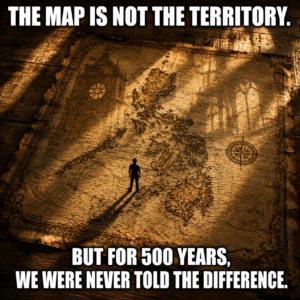
There is a principle in philosophy so simple it should be taught in grade school. Alfred Korzybski, a Polish-American thinker writing in the 1930s, stated it plainly: the map is not the territory.
A map is useful. A map can guide you. But a map is drawn by someone, for a purpose, at a particular moment in history. The territory — the actual ground, the actual river, the actual life being lived — does not change to match the map. The map is always an approximation. The territory is always the truth.
Now ask yourself: what has the Catholic Church in the Philippines been handing Filipinos for five hundred years?
A map.
A map of marriage. A map of family. A map of sin and grace and what God wants from you in the most intimate corners of your life. A beautifully drawn map — ornate, ancient-looking, stamped with the authority of Rome — handed down from generation to generation with a single instruction: this is not a map. This is the ground itself. Do not question it. Do not look for the edges. There are no edges.
And so we did not look.
For five hundred years, the map and the territory were treated as the same thing. A Filipino’s actual marriage — the real, lived, specific, complicated truth of two people bound together — was made to answer to the map’s lines, not the other way around. When the territory didn’t match the map, the territory was told it was wrong. When a marriage became dead, abusive, beyond saving — the map said: this is not possible. What God has joined, no human authority may separate.
The territory — the broken wife, the trapped husband, the children watching their parents destroy each other — was ordered to conform to what the map said should be there.
This is not faith. Faith is personal. Faith is between a person and God. What I am describing is something else: the institutional use of a map to govern real people’s real lives, by an authority that drew the map itself, and that benefits from being the only one allowed to redraw it.
Here is what the map was built on. The Catholic Church teaches that marriage is a sacrament — a holy, unbreakable bond instituted by Christ himself, eternal and beyond revision by any earthly power. Most Filipinos accept this the way they accept that the sun rises. Not because they checked. Because no one ever told them they were allowed to ask.
But what does checking actually reveal?
It reveals that for the first thousand years of Christianity, there was no Catholic wedding ceremony. No priest was required. No sacrament was conferred. The elaborate rites that Filipino Catholics treat as immemorial tradition did not formally exist until 1614 — fifteen centuries after Christ walked the earth.
It reveals that the doctrine of marital indissolubility was assembled piece by piece, between the eleventh and fourteenth centuries, by named men — Hugh of Saint Victor, Peter Lombard, Thomas Aquinas, Duns Scotus — none of whom ever lived inside a marriage themselves.
It reveals that the final political canonization of these doctrines happened at the Council of Trent in 1547 — a council convened not to recover ancient apostolic teaching, but to answer Martin Luther.
The map, in other words, was drawn by specific people, in specific centuries, for specific political reasons. It is not eternal. It is historical. And history, unlike dogma, can be examined.
This is what Veneration Without Thinking asks you to do. Not to abandon your faith. Not to stop believing. But to look directly at the map you have been handed, and ask the question you were trained never to ask: who drew this, and why?
Rizal asked a version of this question about Spain. He paid for it with his life. We turned the anniversary of his execution into a holiday — and then, as Renato Constantino observed, we stopped reading what he actually wrote.
We venerate. We do not think.
This book is an attempt to think. Out loud. In public. Where anyone can read it, push back on it, or take it apart.
The map is not the territory. Your marriage is not a doctrine. Your life is not a line on someone else’s chart.
It is time to look up from the map.
— End of Chapter 1 —
Next week: Chapter 2 — What Do You Know? What Do You Believe? What Are You Merely Assuming? The book is free, in full, every week, here in The City Post. Share it if it made you think.
———————————–
Raffy Gutierrez writes a weekly column on politics, religion, and civil society. The views expressed are solely his own.