
📷: Marcos family
by Diego Morra
Never forget, never again. That is the phrase that those who lived under the bootstraps of the Marcos Sr.’s military during martial law will never erase from their minds. The late Filipino journalist Manuel F. Almario, a lawyer who suffered under martial law, remembered getting wind of the planned imposition of martial law in 1971 after a Marcos Cabinet member had a tete-a-tete with him and told him about the plot, putting into better perspective the bombings of 1971 that culminated with the Plaza Miranda bombing on Aug. 21, 1971 that killed nine people and wounded 100 and the subsequent blasts in 1972 (one of which the CIA blamed on the Partido Komunista ng Pilipinas in a President’s Daily Brief in Washington DC) before martial law was officially announced on Sept. 22, 1972.
Only one suspected bomber was arrested in 1971 and he turned out to be a Philippine Constabulary (PC) soldier. During martial law, several Marines were held in Camp Crame purportedly for their involvement in the Plaza Miranda blasts but apparently, they were never presented to Manila fiscals led by Pedro David who were investigating the bloody incident. Fiscal David eventually dismissed the charges against Jose Ma. Sison for the bombing even as the late Senate President Jovito Salonga wrote later on that he believed Sison was the mastermind based on a claim by his godson, citing a confession by a New People’s Army (NPA) guerrilla that he later repudiated during his Isabela trial, as reported in a banner story of Headline Manila in November 1989.
Moreover, an activist who became a lawyer said he was drinking with the supposed grenade thrower in Quezon City when the attack happened. It was impossible for the alleged grenade thrower to fly from Cubao, Quezon City to Plaza Miranda. A witness before the Senate corroborated the story, thus killing the investigation by the Blue Ribbon panel. Asked by the reporter who wrote the story about the repudiation, the witness kept mum, validating her story. It was a huge scoop by the reporter and the entire military organization could not believe that she had acquired the records of the case after 17 years. It boggles the mind that Marcos took less than 15 seconds to blame the NPA for the Plaza Miranda mayhem and used the “ambush” of Juan Ponce Enrile om Sept. 22, 2026 to justify the declaration of martial law, with Proclamation No. 1081 placing the entire country under martial law being signed on September 19, 1972.
Indeed, there were at least three sets of suspects for the Plaza Miranda bombing, including a group of hoodlums that regularly materializes to claim responsibility for crimes and a convict with close links to some politicians. Marcos Sr. deftly used the bombing, the landing of weapons in Digoyo, Isabela in July 1972 and the explosions in Metro Manila as a plot to overthrow his government since he cannot legally run for another presidential term in 1973. To extend his rule, the only logical option for him and his henchmen was to foment disorder, instigate mindless violence and eliminate the Liberal Party opposition.
These issues are material to a clearer assessment of the rapacity of the Marcos martial law regime, its wholesale violation of the Universal Declaration of Human Rights (UDHR) and international humanitarian laws and its greed for power and disrespect for the civil and political rights of the Filipino people. Amnesty International, Task Force Detainees of the Philippines (TFDP) and similar human rights monitoring groups tagged the Marcos dictatorship for 3,257 known extrajudicial killings, 35,000 documented tortures, 737 “enforced disappearances” and 70,000 incarcerations. A total of 2,520 of the 3,257 murder victims were tortured and mutilated before their bodies were dumped in various places for the public to discover, a grisly tactic to sow fear among the people. Worse, some of these victims were subjected to cannibalism, a fact not hidden from the visiting members of the International Commission of Jurists (ICJ) from late Dec. 1983 to January 1984.
In a statement on the 54th year of martial law, the human rights alliance Karapatan said the continuing exercise of the people’s right to protest is among the most important lessons that must be carried forward from the dark years of authoritarian rule. Beyond remembering the dark days of tyranny and dictatorship, should be a reminder how the government feeds on rampant corruption, anti-people policies, and quelling of dissent. “Martial law taught us that the Filipino people will rise up under a government that silences those who demand accountability for its crimes, and injustice. This is precisely why the right to protest remains indispensable today, despite attempts to block protests and mass actions that express our collective discontent with the Marcos Jr. regime’s perpetuation of corruption, violations of human rights and international humanitarian law, and tyranny, like his dictator-father,” said Karapatan secretary general Cristina Palabay.
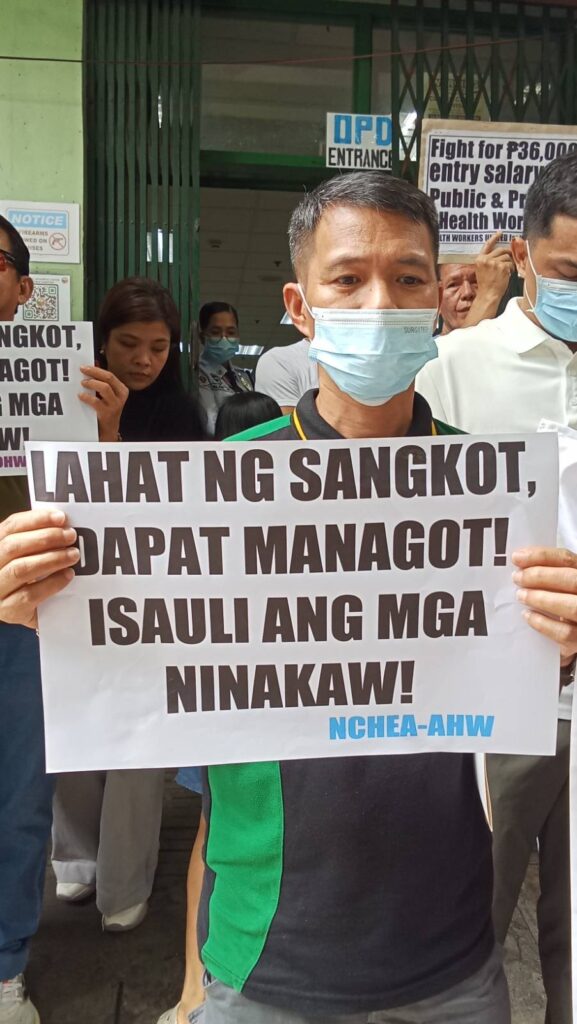
Karapatan condemned the Philippine National Police’s road closures and other restrictions imposed in connection with the September 21 rallies, as well as the suspension of classes in Manila supposedly for safety reasons. Such measures, the group said, should not be used to discourage people, particularly students, workers and ordinary citizens, from joining protests and exercising their fundamental rights.
“We do not need permission from those in power to demand accountability. We have the right to question government policies, expose corruption, criticize officials, and take to the streets when our voices are ignored. This right is vital at a time when billions in public funds are being stolen and government accountability remains a pressing concern,” Palabay argued. The September 21 mobilizations come amid renewed public outrage over alleged corruption in government flood-control and infrastructure projects. Various groups are again expected to take to the streets, coinciding with the 54th anniversary of the declaration of martial law.
“The legacy of martial law remains because the same atrocities continue, more than five decades after. We are taking to the streets to defend people’s rights, as we condemn the State’s utmost neglect of the people’s suffering due to corruption, rabid attacks against the people through red-tagging, unjust arrests, and trumped-up charges, and Marcos Jr.’s sell-out of the Philippines to foreign powers,” said Palabay. KARAPATAN said that the lessons of martial law demand vigilance against repression. “Never again, never forget means defending the rights that the dictatorship tried to destroy. It means refusing to be silenced when public funds are plundered, when corruption is exposed, when human rights are violated, and when government power is abused,” Palabay said. “On this 54th anniversary of Martial Law, we remember, and we resist and fight back,” Palabay concluded.#