by Raffy Gutierrez
I did not set out to write a book about divorce. I set out to write a book about a question that has bothered me for most of my adult life: why does an entire nation of intelligent, capable, hardworking people accept, without examination, an institution’s claim that it alone gets to decide whether their broken marriages can ever legally end?
The answer, once I started researching it seriously, turned out to be more damning than I expected. I had assumed — as most Filipinos assume — that the Catholic Church’s position on indissoluble marriage was an ancient, unbroken teaching, stretching back to the apostles, immune to revision, beyond the reach of ordinary scrutiny. What the historical record actually shows is something else entirely. For the first thousand years of Christianity, there was no Catholic wedding ceremony at all. No priest was required. No sacrament was conferred. The elaborate liturgy Filipino Catholics treat as immemorial tradition did not formally exist until 1614 — fifteen centuries after Christ walked the earth.
That fact alone should stop every Filipino in their tracks. It stopped me. Because if the doctrine we have been told is eternal and unchangeable was, in documented historical fact, assembled piece by piece between the eleventh and fourteenth centuries by a handful of celibate men who never lived inside a marriage themselves, then the entire moral authority claimed by the CBCP every time a divorce bill reaches the Senate deserves to be questioned rather than simply obeyed.
This is the project of my book, Veneration Without Thinking: How Five Hundred Years of Catholic Indoctrination Imprisoned the Filipino Mind — and What It Will Take to Break Free. The title is deliberately uncomfortable, because the condition it names is uncomfortable. Veneration without thinking is what happens when a people are trained, generation after generation, to revere an institution so completely that the capacity to examine it has quietly atrophied. José Rizal diagnosed this condition in the Filipino soul more than a century ago. I am arguing that the diagnosis still applies, and that nowhere is it more visible than in our continued refusal, as a nation, to grant our own citizens the legal right to divorce.
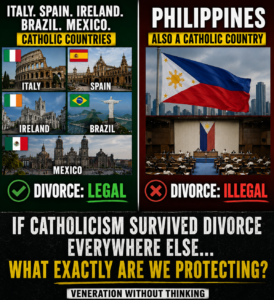
The book is built like a case file, not a sermon. It traces the actual documented history of the Catholic Sacrament of Marriage from its absence in the first Christian millennium, through its construction by named medieval theologians — Hugh of Saint Victor, Peter Lombard, Thomas Aquinas, Duns Scotus — to its political canonization at the Council of Trent in 1547, a decree issued not to recover ancient apostolic teaching but to answer Martin Luther. It examines what the Church’s own scripture actually says, and finds the foundation considerably shakier than four hundred years of unexamined certainty would suggest. It looks honestly at what happens to families, women, and children in every other Catholic-majority country that has already legalized divorce — Italy, Ireland, Spain, Brazil, Mexico — and finds that the catastrophe the CBCP predicts for the Philippines has never once materialized anywhere it was tried.
I want to be precise about something, because I expect to be misunderstood and I would rather not be. This is not a book written to mock Catholic faith or to ridicule the millions of Filipinos who find genuine meaning, comfort, and community within it. What I am attacking is not belief. It is an institutional logic — a four-hundred-year colonial architecture of control that has convinced an entire nation that suffering is sacred, that poverty is divine assignment, and that the decision to leave an unbearable marriage is not yours to make. A Filipino can keep every ounce of their faith and still conclude, on the evidence, that civil law has no business enforcing one religion’s theology on citizens who never agreed to it.
I also wrote this book because I am tired of watching the same argument lose in the Senate, year after year, not because it lacks merit but because the people defending it have never been equipped with the full historical and constitutional case. Pro-divorce advocates in this country are fighting one of the best-funded, most politically embedded institutions in Philippine life, and they are too often doing it with passion alone, against opponents who arrive with two thousand years of borrowed authority. This book exists to change that imbalance. It is, first and foremost, a resource — a reference text for every advocate, every legislator, every ordinary Filipino who has ever found themselves out-argued in a conversation about divorce by someone quoting catechism at them as though catechism settles a question of civil law.
Knowing that this argument would eventually have to survive a hostile room — possibly a Senate hearing chaired by someone with no interest in being persuaded — I made a decision midway through writing that I think strengthens the book considerably. I included a full chapter presenting the five strongest arguments the anti-divorce side can make, stated as fairly and forcefully as I am capable of stating them, and then I took each one apart using the evidence, including the Church’s own internal contradictions. I did this because an argument that refuses to face its best opponent is not an argument. It is a sermon to people who already agree with you. I did not want to write a sermon.
What I am asking of the Filipino reader, ultimately, is not agreement. It is examination. I am asking you to do something the architecture around you was specifically built, over centuries, to discourage: to look directly at the institution that governs the most intimate decisions of your life, and ask whether what it claims about its own authority is actually true. Rizal asked Filipinos to do this about Spain. I am asking Filipinos to do it about an institution that has outlasted Spain by more than a century.
The Philippines and Vatican City remain the only two places on earth without civil divorce. One of them has a population of roughly eight hundred people and is run by an absolute monarch who also happens to be the head of the Catholic Church. The other has a population of one hundred and ten million free citizens governed, in theory, by a Constitution that explicitly guarantees the separation of Church and State. I wrote this book because that comparison should embarrass us, and because embarrassment, properly directed, is the beginning of change.
This book is being released for free, online, because the people who most need to read it are precisely the people least likely to be able to afford it, and because an argument this important should not be gated behind a price tag. I will be publishing it across every major free platform in the coming weeks, and I will be sharing the links here and across social media as each one goes live.
I do not expect this book to be comfortable reading for everyone. I did not write it to be comfortable. I wrote it because five hundred years is long enough to wait for a question that should have been asked generations ago, and because I believe, with everything in me, that the Filipino people are capable of asking it now.
I am not going to let another 500 years pass by and see a Philippines still a Colony of the Cross 500 years from now.
Not on my watch.
__________________
Raffy Gutierrez writes a weekly column on politics, religion, and civil society. The views expressed are solely his own.