By Raffy Gutierrez
There are moments in a nation’s life when corruption stops looking like isolated criminal behavior and starts looking like the operating system of government itself. That is the tragedy of the Philippines today. We are no longer simply talking about one official, one agency, one contractor, one scandal, or one bad transaction. We are talking about a political culture where public money moves through layers of patronage, dynasties, contractors, agencies, and protected networks while ordinary Filipinos are told to be patient, resilient, and grateful for scraps.
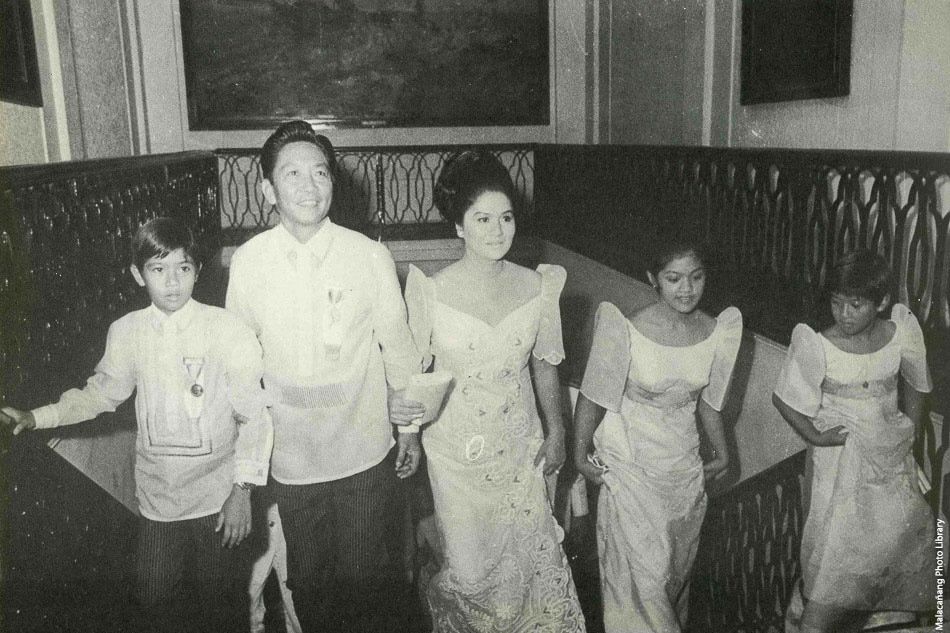
To be legally precise, not every allegation is a conviction. Not every person named in a controversy has been found guilty by a court. But the pattern is impossible to ignore. International anti-corruption research warned as early as 2023 that the election of Ferdinand Marcos Jr. revived fears of state capture by oligarchic family clans and widespread grand corruption, partly because of the history associated with the Marcos name and the political structure around it.
That history is not propaganda. It is in Philippine Supreme Court records. In the Swiss deposits case, the Supreme Court ruled that the Marcoses failed to justify the lawful source of assets involved and ordered the forfeiture of the Swiss deposits in favor of the Republic of the Philippines as ill-gotten wealth. That matters because when people talk about corruption and the Marcos family, they are not starting from rumor. They are starting from judicial history.
This is why the BBM presidency was never just another administration. It was always a test of whether the Philippines had learned anything from the past. Would the son of a dictator whose family name was tied to court-recognized ill-gotten wealth lead a government of transparency, humility, and aggressive reform? Or would old political habits return under new branding?
The answer, so far, is very painful.
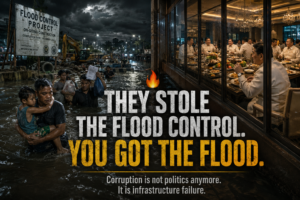
Under the Marcos Jr. administration, the Philippines has faced one of the most explosive corruption controversies in recent memory: the flood-control scandal. Reports from AP, Reuters, Al Jazeera, and other outlets describe investigations into thousands of flood-control projects worth hundreds of billions of pesos, with estimates of massive losses to corruption and allegations involving ghost projects, substandard infrastructure, contractors, engineers, and powerful political figures.
Let that sink in. Flood-control corruption is not just theft. It is theft with dead bodies downstream. When drainage fails, when flood defenses are fake, weak, overpriced, or unfinished, people do not merely lose money. They lose homes, livelihoods, safety, and sometimes lives. The Guardian reported mass protests over missing flood funds, with public anger intensified by deadly typhoons and inadequate flood defenses.
This is the true obscenity of corruption: it is never just numbers on paper. It becomes floodwater in homes. It becomes hunger after disasters. It becomes children walking through polluted water. It becomes families wondering why billions were supposedly spent while their communities still drown.
To be fair, President Marcos Jr. has publicly vowed to prosecute those involved in the flood-control scandal, created a special commission, and announced efforts to freeze assets linked to accused individuals. But this is exactly where Filipinos must learn to think deeper. A crackdown after public outrage is not the same as a clean system before the scandal. Arrests after exposure are not the same as prevention. Commissions after a disaster are not the same as governance.
This is the same pattern we keep seeing across issues: react after humiliation, investigate after outrage, promise reform after the money’s gone. That is not leadership. That is damage control.
And this is why the phrase “unprecedented corruption” resonates with many Filipinos today. The issue is not whether corruption existed before BBM. Of course it did. Corruption has infected Philippine politics for generations. The issue is that under this administration, corruption scandals appear to have become so large, so visible, so connected to life-and-death infrastructure, and so intertwined with elite political networks that citizens are forced to ask whether the state is still governing—or merely distributing access to public money.
The Bertelsmann Transformation Index 2026 report notes active anti-corruption efforts, including Ombudsman prosecutions, but also highlights concerns over weakened oversight institutions, budget controversies, and discretionary funds. That distinction is important. A government can claim anti-corruption action while still operating within a political structure that produces corruption faster than institutions can investigate it.
That is the deeper disease: corruption has become faster than accountability.
The Marcos defense will always be familiar: “There is no final conviction yet.” “The President is investigating.” “Other administrations were corrupt too.” But these arguments avoid the larger point. A nation should not wait for final conviction before recognizing systemic risk. A citizen does not need a court ruling to understand that when public funds vanish, flood projects fail, and officials resign amid controversy, something is rotten in the machinery of government.
The Marcos Jr. administration is facing historically serious corruption controversies, including the flood-control scandal, allegations involving politically connected figures, and public concerns about weak safeguards against state capture and patronage. That is enough to question the administration’s legacy without inventing anything.
And the Marcos clan cannot escape the weight of its name. The family’s past is not a private matter when it has been litigated in public courts, investigated by the state, and tied to recovered assets. The Supreme Court’s forfeiture of Swiss deposits as ill-gotten wealth is not gossip. It is part of the legal record. When a family with that history returns to the presidency, the burden of transparency should be higher, not lower.
Instead, what many Filipinos see is a government still drowning in the same old habits: patronage, personality politics, reactive investigations, selective outrage, and public relations dressed up as reform. The public is told to admire announcements while waiting for results. We are told to applaud crackdowns after scandals while forgetting to ask why the scandals were allowed to grow in the first place.
This is why lifestyle checks matter. This is why transparent procurement matters. This is why public dashboards matter. This is why beneficial ownership disclosure matters. This is why independent auditing matters. Because corruption thrives in darkness, complexity, and delay. The moment government transactions become traceable, searchable, auditable, and publicly visible, the old system starts to panic.
Real anti-corruption reform must be structural, not theatrical. Publish every major infrastructure project in a searchable national database. Show contractor ownership. Show politicians linked to contractors. Show project cost, location, status, photos, geo-tagged progress, payment releases, change orders, and inspection reports. Create automatic red flags for repeated contractors, identical project descriptions, suspicious pricing, delayed completion, and projects marked complete despite field evidence showing otherwise.
Then make lifestyle checks automatic. Not selective. Not political. Not weaponized only against enemies. Every elected official, senior bureaucrat, procurement officer, district engineer, and agency head should be subject to annual, independently audited lifestyle and asset verification. If declared income and visible wealth do not match, the burden should shift toward explanation.
And voters must finally stop pretending they are innocent spectators. Political dynasties survive because voters keep feeding them. Corrupt systems survive because people keep trading standards for familiarity, surname, entertainment, ayuda, local favors, and emotional loyalty. If Filipinos keep electing the same kinds of leaders, they should stop acting shocked when the same kind of government returns.
The BBM legacy, if this pattern continues, will not be remembered as unity. It will not be remembered as competence. It will not be remembered as a clean break from the past. It may be remembered as the moment the Philippines was forced to confront the brutal reality that corruption was not merely hiding in government—it had become one of the government’s most powerful organizing forces.
But this does not have to be the final chapter.
The solution is not despair. The solution is pressure. Relentless, informed, organized public pressure. Demand receipts. Demand databases. Demand lifestyle checks. Demand prosecution. Demand procurement transparency. Demand that every peso taken from the people be traceable from budget approval to actual concrete on the ground.
Because corruption does not end when politicians promise to fight it.
Corruption ends when citizens stop tolerating systems designed to protect it.
And if the Filipino people still have any remaining self-respect as a nation, then this is the line we must draw: never again should public office become a family inheritance, a contractor pipeline, a lifestyle upgrade, or a shield from accountability.
The country does not need another slogan.
It needs a reckoning before it’s too late.
———————–
Rafael “Raffy” Gutierrez is a Technology Trainer with over 25 years of experience in networking, systems design, and diverse computer technologies. He is also a popular social media blogger well-known for his real-talk, no-holds-barred outlook on religion, politics, philosophy.