
by Raffy Gutierrez
Download the free e-book Veneration Without Thinking here:
https://archive.org/details/veneration-without-thinking-by-raffy-gutierrez
Chapter 6: What God Decided For You
There is a phrase so embedded in Filipino daily speech that most Filipinos have never stopped to ask where it came from.
Bahala na.
Leave it to God. Come what may. Whatever happens, happens.
You have heard it your entire life. You have probably said it yourself. It is offered as wisdom — a beautiful Filipino acceptance of uncertainty, a spiritual ease with the things beyond human control, a capacity for peace that more anxious cultures supposedly lack.
Here is what almost nobody tells you about those two words.
Bahala derives from Bathala — the supreme deity of pre-colonial Filipino religion. The phrase, in its original form, was an acknowledgment of the limits of human control and an expression of trust in a higher order that predated the Spanish arrival by centuries. It was an indigenous spiritual expression. It belonged to the Filipino people before the Church ever arrived.
What the colonial Catholic framework did to bahala na is precisely what it did to everything else it encountered in Filipino culture: it absorbed it, redirected it, and put it to work in the service of institutional control.
In its colonial Catholic form, bahala na stopped being an expression of spiritual trust in the face of genuine uncertainty. It became something else entirely. It became the verbal gesture of a people who had been told, repeatedly and from the highest authorities available, that the decisions about their lives were not theirs to make.
Bahala na is not the faith of someone at peace with uncertainty. It is too often the faith of someone who has been told that the decision was never theirs.
The Purpose Vacuum
Catholic theology, in its most complete form, provides a total account of human existence. You were created by God for a specific purpose. Your life has meaning because it participates in God’s plan. Your suffering has significance because Christ suffered. Your poverty is not an injustice to be corrected — it is a spiritual condition that places you in proximity to God.
For the person who has chosen this framework freely — who has examined it, wrestled with it, and embraced it on their own terms — it can be genuinely sustaining. That needs to be said clearly. The framework, freely chosen, is not the problem.
The problem is what happens when it is not freely chosen. When it is not the water you swam toward but the water you were born into. When it is the background hum of every school, every barangay, every family gathering — never offered as one option among others, always presented as the only possible account of reality.
When purpose is assigned rather than chosen, it cannot be amended. When your station in life is understood as God’s assignment, the ambition to change that station becomes spiritual pride — a refusal of God’s will. When suffering is understood as spiritually meritorious, the impulse to end your suffering becomes a refusal of the cross. When poverty is understood as a condition that places you closer to God, asking why you are poor becomes a distraction from the spiritual work of being poor well.
This is the purpose vacuum. The condition in which a person has been so thoroughly instructed in the meaning of their suffering that they have lost access to the more basic question: was this suffering necessary in the first place?
Pagtitiis and Kabanalan
Filipino Catholic culture has built an entire vocabulary around suffering-as-virtue. Nowhere does this vocabulary operate with more force than inside a broken marriage.
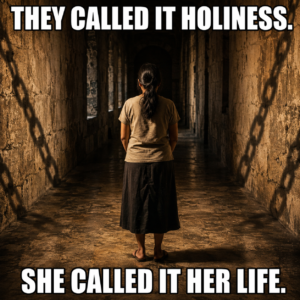
The wife who stays — who endures mistreatment, who offers her suffering to God, who remains in the marriage no matter what it costs her — she is pagtitiis. She is holy. She is praised in homilies, honored in family gatherings, held up as a model of faith.
The wife who leaves — who determines that the marriage is irreparably broken, that her children are better served by her departure than her endurance — she is walang pagtitiis. She has failed the spiritual test. She becomes a cautionary tale. And she carries that failure not just privately but publicly, in the form of social stigma that follows her long after she has rebuilt her life.
The theological architecture of indissoluble marriage and the cultural architecture of pagtitiis reinforce each other with extraordinary efficiency. The doctrine provides the prohibition. The culture provides the social enforcement. Together they create a world in which leaving a broken marriage carries not just legal difficulty but moral condemnation, spiritual failure, and social exile.
A woman trapped in this world does not face one obstacle. She faces three simultaneously: the law that says she cannot leave, the theology that says leaving is a sin, and the community that says leaving makes her less than.
Poverty as Divine Assignment
The same framework operates beyond marriage. The Catholic theology of poverty — in its popular Filipino expression — tends toward the interpretation that poverty is a spiritual condition with spiritual meaning. The poor are blessed. Suffering is redemptive. Endurance is holy.
In its proper context — as prophetic challenge to the wealthy, as genuine comfort to those who suffer unjustly — this is valuable theology. Liberation theology, rooted in exactly these Gospel passages, used the same scriptural material to demand structural change, not passive acceptance.
But popular Filipino Catholicism did not deliver liberation theology to the majority of Filipinos. It delivered the other version — the version that explains why poverty is appropriate, expected, and spiritually productive. The version that provides the poor with a framework in which their poverty is meaningful.
A framework in which your poverty is meaningful is a framework in which your poverty does not need to end.
An ideology that frames suffering as meritorious and poverty as a spiritual condition is an ideology that functions — whatever its intentions — in the interests of those whose comfort depends on the poor not demanding more.
Rizal saw this with devastating clarity in 1887. Padre Damaso in Noli Me Tangere is not a cartoon villain. He is a portrait of institutional power operating exactly as designed — not through malice but through structure. The friar who preaches the holiness of suffering does not need to hate the Filipino. He only needs to keep preaching.
The Marriage Connection
The purpose vacuum, pagtitiis, and the prohibition on divorce are not three separate phenomena. They are three expressions of the same fundamental framework.
A framework that assigns meaning to pain rather than seeking to end it. That locates the solution to human suffering in individual spiritual endurance rather than structural change. That reserves to an institution the authority to determine when and whether individual suffering is sufficient to justify a change in one’s circumstances.
A Filipino woman in an abusive marriage who has been formed in the full Catholic cultural framework does not face merely a legal obstacle. She faces a complete theological account of her situation: her suffering is redemptive, her endurance is holy, her desire to leave is a failure of spiritual commitment, and the institution has not given her permission to go.
Bahala na. Leave it to God.
But in this framework, God has already decided. God decided indissolubility. God decided pagtitiis. The job of the Filipino woman in a broken marriage is to accept the assignment.
The question this book asks — what do you want your life to be? — is radical not because it is philosophically complex.
It is radical because it is simple.
It assumes that you are the appropriate person to answer it. That your life belongs to you. That the answer is not already decided by a medieval theologian, a colonial legal framework, or an institution that has never lived inside a single Filipino marriage.
It is the question that the entire machinery of veneration without thinking was designed to prevent you from asking.
And it is the question that the next chapter brings into its sharpest, most specific, most undeniable focus — because the framework that assigns your suffering its meaning is the same framework that has built a system of exit available only to those who can afford it.
— End of Chapter 6 —
Next week: Chapter 7 — Divorce for the Rich, Suffering for the Poor. The annulment system, what it actually costs, and what it reveals about a doctrine that calls itself sacred while functioning as a class policy. Free, in full, every week, right here in The City Post. If this made you think, share it with someone who needs to.
————————-
Raffy Gutierrez writes a weekly column on politics, religion, and civil society. The views expressed are solely his own.