
by Diego Morra
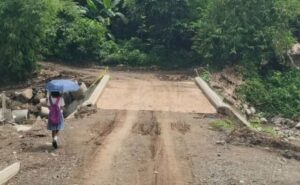
The Department of Agriculture (DA) has been hyping the use of the₱33.9-billion budget for farm-to-market roads (FMRs) in the 2026 budget that covers 2,750 kilometers even as it hasn’t fixed the anomalies that covered 1,635 FMRs, many of them perpetrated in 20223 and 2024, when the DA was supposed to help oversee those projects in Bicol and Tacloban City that were overpriced while nine projects in Mindanao never materialized.
Moreover, these FMRs are being discussed at a time when the seriousness of President Ferdinand R. Marcos Jr. in pursuing the lofty targets of the Comprehensive Agrarian Reform Program (CARP) is in serious doubt. There appears to be deeper reasons why the administration seeks posthaste to build FMRs in areas that may later on be the sites of large agricultural estates for foreign investments, as conceived by the Maharlika Investment Corp. The head honcho of the sovereign wealth fund (SWF) even thought of consolidating CARP areas to host webs of telecommunications towers and agribusiness ventures.
The enactment of the law allowing 99-year land leases for foreign corporations and the amendment to CARP that allows beneficiaries to combine and then sell or lease their land are premised precisely to lure foreign capital rather than mechanize agriculture and diversify farm production and develop domestic and foreign niche markets. No wonder the Federation of Filipino-Chinese Chambers of Commerce and Industry, Inc. (FFCCCII) ran ads in June 2025 to champion the expanded land lease bill, along with a surfeit of legislative proposals favoring Chinese corporations as well as other companies backed by the ever-meddling Joint Foreign Chambers of Commerce. Comically, the FFCCCII claimed that the leased land “must align with national development goals” and foreign capital must respect Philippine sovereignty. This is akin to selling the country down the drain by surrendering the majesty of Philippine law, as disputes are covered by foreign courts or arbitration panels.
Under the byzantine bureaucracy of the Department of Agrarian Reform (DAR), which has exclusive jurisdiction over land cases, a total of 98,9939 hectares were reclassified from agricultural to commercial, residential and industrial land from 1998 to 2016. For its part, the National Irrigation Administration (NIA) confirmed that 165,000 hectares of prime irrigated land are lost annually to various uses, primarily residential and commercial, driven by urbanization, with Luzon accounting for 80% of those conversions. DAR and NIA confirmed that residential conversion accounted for 57.77% of the total, followed by commercial conversion at 15.26%. The tragedy is that both agencies are supposed serve the agricultural sector and millions of farmers dependent on their small shares of arable land but they have privy to wholesale land conversions. They were missing when farms in Carmona, Cavite were converted into golf courses, rendering a newly-built irrigation system useless.
In Iloilo, irrigated land ended up being owned by the Villar political dynasty to be converted in a commercial center that suffers low foot traffic. Consider as well the authority of local government units (LGUs) to reclassify land within their jurisdictions, with former rice lands, poultry and livestock farms being declared commercial zones as they fall within a kilometer or so of an expressway or a convenience store. Certainly, LGUs out to increase their revenue would always opt to reclassify farms into commercial zones, subjecting the same to overvaluation the way Manny Villar does to his landbanked assets. In truth, many LGUs, particularly in Luzon, have failed to develop their farming areas since most of them do not have agricultural personnel, contrary to their mandate under the devolution provision of the Local Government Code (LGC.)
The Kilusang Magbubukid ng Pilipinas (KMP) is certainly justified in describing the 2026 national budget as one that swims in pork barrel funds and bloated allocations for corruption, militarization and anti-people programs. KMP chairperson Danilo Ramos noted that the budget pays lip service to the urgent needs of farmers and the Filipino people at large. There is presidential pork, congressional and LGU pork, soft pork, and generals’ pork amounting to hundreds of billions of pesos. The ₱243-billion unprogrammed appropriations (UA) also serves as a massive presidential slush fund with no clear safeguards It is notoriously known as a super-discretionary fund that does not pass muster genuine generally acceptable auditing procedures.
This enormous fund gives Marcos Jr. an ocean of opportunity to ship money to himself, his cronies, favored politicians, contractors and political allies. “This budget is a continuation of bureaucrat capitalism at its worst. While farmers are pushed deeper into debt and poverty, Marcos Jr. ensures that pork barrel funds remain intact to secure political loyalty and patronage,” Ramos protests. “Hindi ito badyet para sa mamamayan. Ito ay badyet para sa pork, patronage, at political survival ng rehimeng Marcos na lubhang kinasusuklaman ng taumbayan.” KMP also denounced the huge allocations for programs that fuel fascism in the countryside. The P8.08-billion Support to the Barangay Development Program (BDP) under the NTF-ELCAC, also known as the generals’ pork, has been retained and expanded.
This fund has repeatedly been used to militarize rural communities, coerce barangays into declaring themselves “cleared,” and reward local officials who cooperate with counterinsurgency operations, instead of addressing the roots of poverty and landlessness. Both the NTF-ELCAC and the AFP have failed to decimate the New People’s Army (NPA) and the revolutionary movement in 2025, as what Marcos Jr. had expected. Marcos Jr. also controls P11-billion in confidential and intelligence funds (CIF) that he had increased for his own office, the AFP and PNP. This dark money finances such dark activities as surveillance, red-tagging, harassment and violent operations against peasants, activists, and rural communities.