by Raffy Gutierrez
Download the free e-book Veneration Without Thinking here:
https://archive.org/details/veneration-without-thinking-by-raffy-gutierrez
Serialized Chapter 4: What Their Own Bible Says
The Church tells you the Bible settles this. Read it carefully, and the Bible does something else entirely — it opens the question back up.
Three verses carry the entire weight of Catholic marriage doctrine: Genesis 2:24, Matthew 19:3-9, and Ephesians 5:22-32. These are the load-bearing walls. Look closely at any one of them, and the wall is less solid than you were told.
The Word That Was Never There
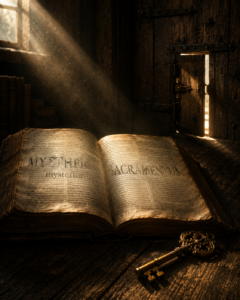
Ephesians 5:32 is the single most important verse in the Catholic theology of marriage. The old Latin Bible translated it as sacramentum hoc magnum est — this is a great sacrament.
But Paul didn’t write “sacrament.” He wrote mysterion. Mystery. Something profound, something not fully explained — not a technical rite that confers grace. Paul was marveling at a comparison he’d just drawn between husband and wife, Christ and the Church. He wasn’t founding an institution. He was expressing awe at a metaphor.
That single word — mystery, quietly become sacrament over centuries of Latin translation and theological drift — is the linguistic foundation the entire indissolubility doctrine stands on.
The Exception the Church Argues Away
Then there’s Matthew 19. Jesus tells the Pharisees that anyone who divorces his wife, except for sexual immorality, and remarries commits adultery.
Except for. That clause is in the text. Protestant traditions have long read it as exactly what it says — a real exception, real grounds for divorce. The Catholic Church reads it narrowly, defining the exception almost out of existence. This isn’t the only honest reading of that verse. It’s the one reading the institution needed.
The Church’s Own Divorces
And here’s the part that should stop every Filipino Catholic mid-scroll: the Catholic Church already dissolves marriages. It has always dissolved marriages.
The Pauline Privilege lets the Church declare a believer “not bound” when an unbelieving spouse leaves. The Petrine Privilege lets the Pope personally dissolve a valid sacramental marriage. Non-consummated marriages can be dissolved by the Pope for any reasonable cause, at any time.
Read that again. The Pope can end a marriage. The doctrine was never “no exceptions.” It was “no exceptions unless we grant one” — and the power to grant it has always stayed inside the same walls that wrote the prohibition.
Six Hundred Theologians Said So, in the New York Times
In 1968, after a papal commission spent three years studying birth control and recommended change by a clear majority, Pope Paul VI rejected them anyway. Within days, over six hundred Catholic theologians signed a public statement of dissent — printed in the New York Times.
The Church’s own scholars, in public, on the record, disagreeing with Rome. That happened. It is documented. The idea that Catholic doctrine on marriage and sexuality has always spoken with one unified voice does not survive contact with the Church’s own history.
What This Means
The scriptural foundation is contested — even inside Catholic scholarship. The theology was built by specific men, in specific centuries, responding to specific pressures. And the institution that tells a Filipino wife she cannot leave her marriage has, for centuries, kept a set of keys marked exceptions — keys it has never handed to her.
That is not settled doctrine. That is a system with a side door, open only from the inside.
The scripture is contested. The theology was built by particular men, in particular rooms, for particular reasons. It’s time to meet them — and ask what qualified a room full of celibate men to write the permanent rules for everyone else’s marriage. Chapter 5 will be out next week, only here at The City Post online.
— from Veneration Without Thinking, Second Edition, by Raffy Gutierrez Free to read and share (CC BY-NC-ND 4.0) — full book available now
————————-
Raffy Gutierrez writes a weekly column on politics, religion, and civil society. The views expressed are solely his own.