
📷gazettengr.com
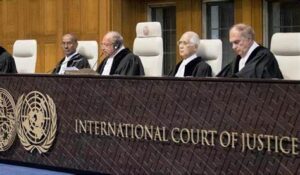
The International Court of Justice (ICJ) ordered Israel on Monday to immediately halt its military offensive in the southern Gaza city of Rafah.
In its ruling, the world court said it was “not convinced” that the evacuation of Rafah and other measures by Israel are sufficient to “alleviate the suffering of Palestinians.”
The ICJ also said that, in order to preserve evidence, Israel must take measures to “ensure unimpeded access into the Gaza Strip for inquirers.”
While reading the ruling, the ICJ President, Nawaf Salam, said that the humanitarian situation in Rafah has “deteriorated further” since the last court order.
He also added that the court is told that the humanitarian situation is now classified as “disastrous.”
Today’s ruling followed a request to order Israel to halt its offensive in Rafah, in a case brought by South Africa accusing Israel of genocide.
South Africa’s Requests
South Africa had requested that the court urge Israel to immediately cease its military offensive against Rafah, withdraw its forces, and ensure unimpeded humanitarian access to Gaza.
Additionally, South Africa asked the court to order Israel to allow UN officials, humanitarian organizations, journalists, and investigators to enter the Strip without hindrance.
“Israel has so far been ignoring and violating the orders previously issued by the court,” South Africa asserted.
Plausible Risk of Genocide
In January, the ICJ called on Israel to avoid actions that could lead to genocide and to facilitate humanitarian access to Gaza.
A few weeks later, South Africa requested additional measures in response to Israel’s announced intention to attack Rafah, but the court rejected this request.
At the beginning of March, South Africa renewed its request for emergency measures against Israel.
Later that month, the court ordered Israel to ensure the delivery of “urgent humanitarian aid” to Gaza, in light of “a famine that has begun to spread” in the war-torn Strip.
Genocide Case
Recently, countries including Libya, Egypt, and Turkiye announced their intention to support South Africa’s lawsuit in the genocide case against Israel in the ICJ.
These hearings are part of an ongoing case in which Israel is accused of genocide.
It is important to note that the rulings and orders of the ICJ are binding and cannot be appealed, although the court has no enforcement mechanism.
However, an order against a country can damage its international reputation and set a legal precedent.
Two weeks ago, Israeli occupation forces began a military operation in Rafah and instructed residents and displaced individuals to move to Khan Younis in the southern Gaza Strip.
Staggering Death Toll
Currently on trial before the International Court of Justice for genocide against Palestinians, Israel has been waging a devastating war on Gaza since October 7.
According to Gaza’s Ministry of Health, 35,709 Palestinians have been killed, and 79,990 wounded in Israel’s ongoing genocide in Gaza starting on October 7.
Moreover, at least 11,000 people are unaccounted for, presumed dead under the rubble of their homes throughout the Strip.
Palestinian and international organizations say that the majority of those killed and wounded are women and children.
The Israeli war has resulted in an acute famine, mostly in northern Gaza, resulting in the death of many Palestinians, mostly children.
The Israeli aggression has also resulted in the forceful displacement of nearly two million people from all over the Gaza Strip, with the vast majority of the displaced forced into the densely crowded southern city of Rafah near the border with Egypt – in what has become Palestine’s largest mass exodus since the 1948 Nakba.
Israel says that 1,200 soldiers and civilians were killed during the Al-Aqsa Flood Operation on October 7. Israeli media published reports suggesting that many Israelis were killed on that day by “friendly fire.” | The Palestine Chronicle