
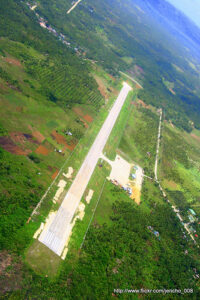
Indigenous peoples’ rights group KATRIBU has raised concerns over the construction of Bukidnon’s first airport, saying the project has displaced Lumad families and may have proceeded amid unresolved questions surrounding the Free, Prior, and Informed Consent (FPIC) process required for projects affecting ancestral domains.
In a statement, KATRIBU said around 113 families from the Kirintëkën-Ilantungën Mënuvu tribe were relocated from their ancestral lands to a resettlement area in Barangay Maray-Maray, citing reports that the community continues to face challenges related to basic services and livelihood opportunities.
The group said the affected families previously relied on farming corn, cassava, sweet potatoes, and fruit-bearing trees on lands they had cultivated for generations.
The organization argued that the displacement illustrates what it described as the social cost of infrastructure-led development, warning that economic growth projects should not come at the expense of Indigenous peoples’ rights and welfare.
While the airport is expected to improve connectivity and stimulate economic activity in Bukidnon, KATRIBU said such benefits must be weighed against the impact on ancestral communities.
KATRIBU also questioned whether the project fully complied with FPIC requirements under the Indigenous Peoples’ Rights Act (IPRA).
According to the group, the National Commission on Indigenous Peoples (NCIP) provincial office has acknowledged that the airport site lies within an ancestral domain, while the Department of Transportation (DOTr) reportedly said an earlier FPIC application did not push through, prompting the filing of a new application after original documents could no longer be located.
The group said representatives of the affected community have raised concerns over whether the consent process was properly completed and whether a Certificate of Precondition, a requirement for projects affecting ancestral domains, had been secured prior to construction.
“FPIC is not merely a procedural requirement but an expression of Indigenous peoples’ right to determine what happens to their ancestral lands,” KATRIBU said, adding that development projects should not proceed by circumventing or weakening consent processes.
KATRIBU called on the NCIP, DOTr, and relevant local government units to publicly clarify the status of the FPIC process and the project’s Certificate of Precondition, investigate possible procedural lapses, and address concerns raised by affected communities.
The group also urged authorities to halt construction activities pending the resolution of questions surrounding compliance with FPIC requirements.
The organization said the case reflects broader concerns over development projects in Indigenous territories, arguing that ancestral lands should not be treated solely as economic assets and that Indigenous communities must be given a meaningful role in decisions affecting their lands, relocation, and future.# (ZIA LUNA)