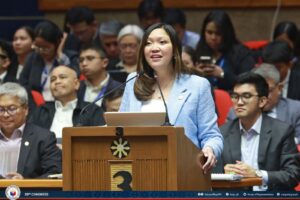
📷: House Appropriations Committee Chairperson and Nueva Ecija Rep. Mika Suansing
The People’s Budget Coalition (PBC) urged the House Committee on Appropriations to publicly release documents supporting nearly ₱190 billion worth of budget insertions in the proposed 2027 national budget, warning that the lack of transparency could fuel another major public spending scandal.
In a statement, the coalition said its partial risk analysis, conducted with governance watchdog BetterGov.PH, found almost 7,000 projects in the House-approved budget with a combined value of about ₱190 billion that were not included in the National Expenditure Program (NEP) submitted by Malacañang.
The group stressed that the findings do not constitute proof of corruption but said the unexplained insertions are “red flags” that require public explanation and supporting documentation.
“An insertion is not by itself a proof of corruption, but it is a red flag that needs to be explained publicly,” the coalition said, adding that although Congress has the authority to amend the budget, project amendments should be backed by publicly available documents.
PBC warned that passing the budget without an independent verification system could lead to another controversy similar to past flood-control spending scandals, potentially involving other agencies.
The coalition said the House appropriations process remains a “black box” because the public lacks access to detailed records showing what amendments were introduced, who proposed them, and why they were approved.
The group clarified that the ₱190 billion figure represents the gross value of what it described as unsupported insertions across the Department of Public Works and Highways (DPWH), Department of Agriculture (DA), Department of Health (DOH), and National Irrigation Administration (NIA), and does not necessarily reflect a net increase in budget allocations.
PBC also said its review could not identify which lawmakers were responsible for the amendments, noting that district engineering offices may cover multiple congressional districts and that party-list-backed amendments cannot be traced through currently available records.
The coalition described its findings as “partial and unofficial” and said it is prepared to update its analysis if the House committee releases supporting documents and establishes a process for public verification.
Among its recommendations, the group urged the House appropriations panel to publish a complete itemized record of all amendments, disclose who proposed and approved each change, release project-level technical documents, and establish a mechanism for verification, correction, and public feedback.
The coalition also called on senators to remove, and on the President to veto, any budget insertion or amendment that fails technical review and public scrutiny.
“Our findings are an invitation to verify,” the group said. “Using these findings to smear individuals or to discredit the whole budget process works against the very thing we’re asking for: a budget that every Filipino can verify and trust.”
PBC said restoring transparency in the budget process is essential to rebuilding public confidence in how taxpayer funds are allocated and spent. # (ZIA LUNA)