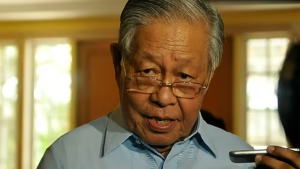
(SYNOPSIS RELAYED TO THE COURT BY CLERK OF COURT RENATO BANTUG)
NUMBER ONE, WHETHER THE PHRASE “ALL MEMBERS OF THE SENATE” IN ARTICLE XI, SEC. 3 (6) OF THE CONSTITUTION SHOULD REFER TO THE SENATE’S FULL MEMBERSHIP OF TWENTY-FOUR SENATORS OR ONLY THOSE WHO ARE LEGALLY AND PHYSICALLY CAPACITATED TO PARTICIPATE AND VOTE ON THE FINAL QUESTION IN AN IMPEACHMENT TRIAL.
I was one of the Delegates to the 1971 Constitutional Convention which drafted the 1973 Constitution, and one of the Commissioners of the Constitutional Commission of 1986 which drafted the 1987 Constitution of the Republic of the Philippines. There was no debate on this subject during the deliberations in both the 1973 Constitutional Convention and in the Constitutional Commission of 1986. It was presumed and assumed that when the Constitution mentioned “two-thirds” of all the Members of the Batasang Pambansa in the 1973 Constitution and of the Senate in the 1987 Constitution, or three-fourths of all the Members of the Senate in the 1935 Constitution, the word MEMBERS refers to LIVING PERSONS WHO ARE NOT SUFFERING FROM ANY MENTAL, PHYSICAL OR HEALTH CONDITIONS WHICH RENDER THEM INCAPABLE OF EXERCISING THEIR POWERS OR PERFORMING THEIR DUTIES AS SENATORS, OR WHO ARE PHOHIBITED TO DO SO BY REASON OF SOME LEGAL RESTRAINTS OR IMPEDIMENTS. THIS IS THE SPIRIT OF THE PROVISION. It could not be otherwise. Any interpretation to the contrary would defy reason, logic and common sense; tolerate an absurdity; and perpetuate an injustice.
The framers of the Constitutions of 1935, 1973 and 1987 could never have intended to include in “ALL MEMBERS” Senators in a given Congress the following: (1) those who have resigned or have been expelled; (2) those who suffer from any mental infirmity as, for instance, those in any state of insanity or who are suffering from Alzheimer; (3) those who are suffering from any physical incapacity, such as the deaf and the dumb, the blind, or those in hospitals or at home suffering from terminal cancer or are in comatose condition, or under tracheotomy; (4) those who cannot participate in the hearings and deliberations on the impeachment, such as those who are outside the jurisdiction of the Philippines, or whose whereabouts are unknown or in hiding to avoid arrests; and (5) those who by reason of some legal impediments or restraints, cannot exercise or perform their rights and privileges as a public official or, more specifically, as a Senator.
The last group include those who are charged in court for Plunder defined in and penalized by Republic Act No. 7080, approved on July 12, 1991; and for violation of the Anti-Graft and Corrupt Practices Act (Republic Act No. 3019); and those who are facing criminal charges in court or have been convicted and are serving their sentence.
We also have decisions of the Supreme Court which clearly decree that public officers facing criminal cases in court cannot, during the pendency of their cases, practice their profession nor hold office, elective or appointive while in detention.
CLEARLY THEN, THE BASIS OF COMPUTING THE TWO-THIRDS MUST BE THE NUMBER OF SENATORS WHO ARE QUALIFIED TO VOTE. NOT THE TWENTY-FOUR (24) IN THE PRESENT SENATE. ALL THOSE DISQUALIFIED BY REASON OF CAUSES EARLIER MENTIONED SHOULD NOT BE INCLUDED.
NUMBER TWO, WHETHER OR NOT THE CASE OF JOSE AVELINO V. MARIANO J. CUENCO (G.R. NO. L-2821, 4 MARCH 1949), PARTICULARLY ITS TREATMENT OF MEMBERS BEYOND THE COERCIVE JURISDICTION OF THE SENATE, APPLIES IN DETERMINING WHETHER SENATORS WHO ARE DETAINED, ABROAD, SUSPENDED, OR WHOSE WHEREABOUTS ARE UNKNOWN, ARE INCLUDED IN THE PHRASE “ALL THE MEMBERS OF THE SENATE” FOR PURPOSES OF THE TWO-THIRDS VOTE REQUIRED UNDER ARTICLE XI, SEC 3(6) OF THE CONSTITUTION.
The primary question that confronts us in this issue is whether the decision in Avelino vs. Cuenco is applicable in Impeachment cases. The undersigned respectfully submits that it is not directly applicable in Impeachment cases. However, by analogy, it may only provide some guiding light. It was a divided Supreme Court of eleven members– a Chief Justice and ten Associate Justices (Sec. 4, Article VIII, 1935 Constitution).
The matter in issue in this Avelino vs. Cuenco case was purely relative to the determination of quorum in a Senate exclusively acting as a legislative body, and performing exclusively legislative functions, and not as an Impeachment Court.
At the session of the Senate on February 21, 1949, Senators Sotto and Confesor were absent. The first was confined in a hospital and the second was in the United States. Effectively then there were only 22 Senators. A majority of the 22 Senators would only be 12. Respondent Cuenco was elected by 12.
May this decision in Avelino vs. Cuenco be applied in a Senate acting as an Impeachment Court? The Impeachment Court can consider this as having a persuasive value. Nevertheless, in light of the disquisitions above on the first issue, we now can conclude that those who are detained, abroad, suspended or whose whereabouts are unknown cannot be included, or must be excluded, from the phrase “all the Members of the Senate.”
Number three, WHETHER OR NOT A SENATOR-JUDGE WHO DID NOT ATTEND OR SUBSTANTIALLY PARTICIPATE IN THE IMPEACHMENT PROCEEDINGS AS TO, AMONG OTHERS, PROPOUND QUESTIONS TO AND OBSERVE THE DEMEANOR OF WITNESSES, MAY NEVERTHELESS VALIDLY CAST A VOTE ON THE FINAL QUESTION IN AN IMPEACHMENT TRIAL.
This issue is not easy to answer.
Nevertheless, the undersigned will do so with the preliminary statement that the Senators, now addressed as Judges, in an impeachment case are, in conscience, duty-bound to think, believe, act and behave as Judges in the contemplation of the Constitution. They are thus to have in their favor the presumption that they possess or must possess the virtues of “proven competence, integrity, probity and independence. ” These are what the Constitution requires of a justice or judge under Section 7, paragraph 3 of Article VIII of our 1987 Constitution:
Each must, as well, be guided by the Oath of Office he or she took as a Senator-Judge. Accordingly, a Senator-Judge who did not attend any session of the Court for any reason whatsoever or who never acted or performed the duties as a Senator-Judge must be deemed to have never participated in the performance of the duties as such. He should belong to the category of those who are outside the jurisdiction of the Philippines or in a foreign country or one whose whereabouts are unknown.
As to those who did not substantially participate in the impeachment proceedings, the undersigned leaves this matter to the conscience and sense of duty to those involved. They must never forget that they are public officials who are solemnly bound to observe and practice Section I of Article XI of the Constitution on Accountability of Public Officers, which reads:
“Public office is a public trust. Public officers and employees must, at all times, be accountable to the people, serve them with utmost responsibility, integrity, loyalty, and efficiency, act with patriotism and justice, and lead modest lives.”
I wish to underscore, however, that failure to ask questions on the witnesses is not proof of non-participation. As judges, they should even refrain from asking questions except to clarify a point. Judges are to be present at all times and to listen to and reflect on the testimonies of witnesses.#