by Diego Morra
Filipino journalists have actually been walking on eggshells since 2016, when then President Rodrigo Duterte said newsmen are as vulnerable to physical attacks as any other citizen of the republic, especially when journalists purportedly abuse press freedom and engage in hit jobs and deny the subjects of their commentary the right to reply.
Duterte’s law thus justifies, not due process of law, not the protection of journalists, but the right of armed reply to abusive reporters and columnists, commentators and editors. Journalists are responsible for what they write, whether right or wrong, or whether or not their reporting is beyond reproach or not. Yet, the context of Duterte’s law is not the protection of the aggrieved but the sanctification of vengeance. Certainly, the people of Davao City knew what happened to Jun Pala, once pals to Duterte but broke with him over what the latter reported was a graft-ridden waste disposal deal.
Pala was killed in 2003 by a team that was recruited by Duterte and his henchmen, according to a very long affidavit executed by former police officer Arturo Lascanas, a confessed member of the Duterte Death Squad (DDS) who revealed the many murders perpetrated in Davao City, including the massacre of entire families, the disappearance of young men who figured in a fistfight with a Duterte relative, the killings of petty criminals and the summary execution of perceived political enemies. Lascanas’ disclosures hewed closely to the pieces of information that the late broadcaster Waldy Carbonell had gathered when he was sent to Davao City by former National Press Club of the Philippines (NPC) president Tony Antonio to investigate Pala’s murder in 2003.
Pala, who was once elected Davao City councilor, was not only critical of the DDS killings under the baton of Duterte; he likewise slammed graft-ridden projects in the city, like the P1-million daily budget for waste disposal. Carbonell said experts estimated that only P200,000 was needed for trash collection and disposal daily. When Carbonell sought to interview Duterte, the mayor flew into a rage and said he will slap the broadcaster, shoot him dead and bury him vertically. Carbonell told Davao City journalists he will also slap Duterte, who was shorter than him as he stood at 6’ 3.” An indignant Duterte challenged Carbonell to a duel and the broadcaster obliged him.
Coming in from Gen. Santos City, where he served as councilor before martial law was declared, Carbonell toted his reliable pistol and motored to City Hall at the appointed time, only to be told, after 30 minutes of waiting, that the brave Duterte flew to Taiwan so his possible appointment with the Angel of Death had to be cancelled. By not being at the appointed time and place, Duterte failed to prove that he can do a repeat of the duel between Alexander Hamilton and Aaron Burr. It was some kind of skedaddle that left a bad taste in the mouth of a gallant adversary.
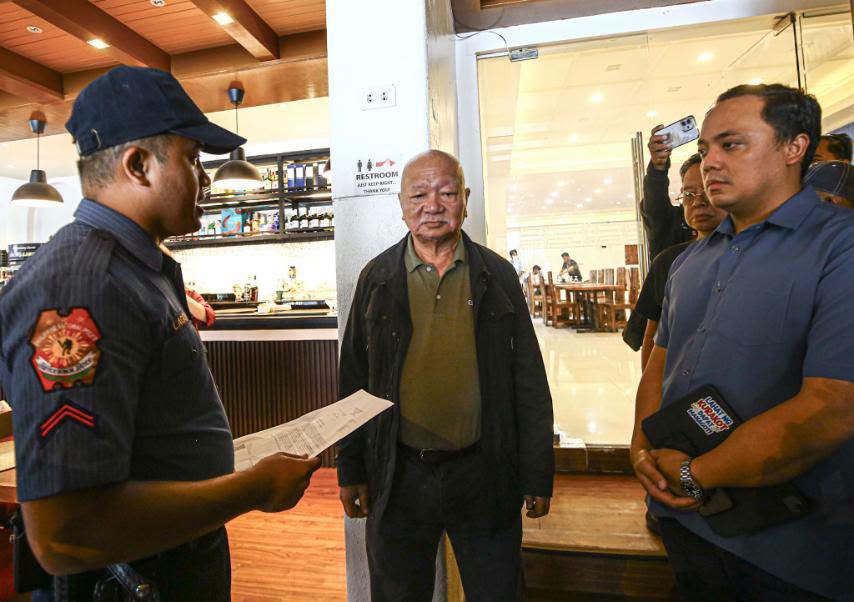
However, Atty. Manases “Mans” Carpio is not Digong and he is far removed from the antics of his father-in-law even as his maneuvers leading to the filing of a cyberlibel against tabloid columnist Philip Lustre are classic schemes to use legal ploys to ensure that the complainant will not have a chance to a mandatory preliminary investigation to hasten the trial. Failing to get Lustre’s side was a deliberate move that favors Carpio. How the prosecutors and the police did not get the real address of Lustre is a mystery.
It was strange that the judge who issued the arrest warrant, Judge Retrina Espe Fuentes of Regional Trial Court (RTC) Branch 10, did not bother to see the accused or question the prosecutors if the respondent were informed that he was being charged criminally for violating Sec. (4C) 4 of the Cybercrime Prevention Act of 2012, also known as Republic Act No. 10175. This is elementary but then a different kind of law must hold sway in the Duterte fiefdom, particularly among the Davao City prosecutors, who have taken to heart the lessons about railroading cases, fabricating evidence and pressuring litigants to settle in an unfair and unjust manner. Some may call this shared legal psychosis. Fuentes was the same judge who issued the arrest warrant for Davao Death Squad (DDS) whistleblower Arturo Lascañas in 2017 after he turned his back on Rodrigo Duterte. Lascanas tagged Duterte as the architect of the “tokhang” murders. Eventually, Lascanas fled the country and revealed everything he knew about the slaughter of 30,000 people during the anti-drug war as well as the murders of the enemies of the Duterte political dynasty.
With Pulong Duterte also filing libel and cyberlibel complaints against Channel 7 chairman Felipe Gozon and CEO Gilberto Duavit and news presenters Mel Tiangco, Emil Sumangil and Vicky Morales as well as National Bureau of Investigation (NBI) director Melvin Matibag before Davao City prosecutors on Oct. 23, 2026 for the video report on the allegations of former police officer Rodulfo Gracioso Jr. that he delivered P100-million to the Dutertes, the stage is set for the avalanche of criminal charges against those who have written and commented on cases involving members of this political warlord family of Davao City. Curiously, the prosecutor handling the case is a cousin of yet another player for the political dynasty and this alone compelled Matibag to seek the prosecutor’s inhibition. Gozon, known to his classmates at the UP College of Law as “Henry,” would surely not countenance the weaponization of the Cybercrime Prevention Act of 2012, also known as Republic Act No. 10175. Rather than stimulate thorough discussions of public issues, RA 10175 is now being used to stifle fair comment, stunt reporting based on facts and documents and promote a climate of fear. It is time to get out of retirement, Henry, and take the cudgels of a stiff war versus Duterte’s quockerwodgers.#