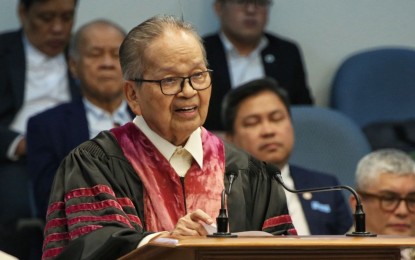

I thank your honors for the invitation to speak before you as an amicus. I humbly apologize for not preparing a PowerPoint presentation. I was able to write out my thoughts on the issues confronting us–only late last night. I will be happy, however, to submit a more extended, amicus brief if required by your honors.
Before expressing my view, on the proper interpretation of Article 11, Section 3 (6) of the 1987 Constitution. Let me address a vital issue raised by even some members of this court. The question is asked, whether this impeachment court has any power to interpret the meaning of that sentence, “No person shall be convicted without the concurrence of two-thirds of all the members of the Senate.”
My respectful submission, Your Honors, is that the Senate as an impeachment court possesses the power to interpret the meaning and nuances of that sentence. That power is derived from Articles 11, Section 36 of the Constitution itself, which expressly provides “The Senate shall have the sole power to try and decide all cases involving impeachment. Please note the use of the word “sole” which means the only body that can try and decide all cases involving impeachment. The sole power to try and decide necessarily includes the lesser power to promulgate the rules that will govern the trial and decision of impeachment cases. The objection is made that given that power to interpret, the senator-judges may change the literal meaning of the number of judges that can convict and therefore violate the Constitution. Again, with due respect, the literal interpretation of the threshold number of votes to convict is just one school of interpretation that follows the principle verba legis non est recedendum. Meaning, from the words of the law, there shall be no departure. But your honors, there is another school of thought that follows a different approach when interpreting a constitutional provision.
The proponents of this school of thought adopt the contextual approach or the holistic approach which requires the interpretation of other related and relevant provisions of the Constitution to determine the intent and purpose of the people. Both interpretations have constitutional support.
Next, Your Honors, let me address the thesis that the Supreme Court alone has the power to interpret Article 11, Section 3(6) of the Constitution. Again, this thought requires a proper understanding of the constitutional provision giving the Senate the sole power to try and decide impeachment cases. The power granted to the Senate impeachment court by the Constitution is judicial power, the power to adjudicate. The power to decide cases. In discharging this judicial power, the Senate Impeachment Court is not under the Supreme Court. The senator judges are not like the judges of the regular courts of law who are all under the supervision of the Supreme Court. It is for this reason, Your Honors, that the Senate Impeachment Court was granted judicial power under Article 11, Section 3(6) of the Constitution entitled Accountability of Public Officers. Its judicial power was not granted under Article 7 of the Constitution entitled Judicial Department. Article 7 entitled Judicial Department contains an exhaustive discussion of the powers of the Supreme Court. Nowhere does it explicitly appear in Article 7 that the Supreme Court can review the rules of the Senate Impeachment Court. Nowhere does it appear in Article 7. That the Supreme Court can review how the Senate should conduct its trial. Nowhere does it appear in Article 7 that the Supreme Court can review the evidence of the parties given in the impeachment court. Nowhere does it appear in Article 7 that the Supreme Court can review how the Senate impeachment court should decide impeachment cases. In general, Your Honors, all these questions are to be resolved alone by the Senate Impeachment Court because it is the sole judge to try and decide impeachment cases.
The decisions of the Senate Impeachment Court on these matters are what we call political questions. Questions that are addressed to the wisdom of the senator judges. Questions that are policy matters which the senator judges alone should decide. Having said that, your honors, let me, however, emphasize that not all the actions taken by the Senate Impeachment Court in the exercise of its sole power to try and decide impeachment cases are political in character.
There are certain actions which cannot be categorized as political in character. And these actions can be reviewed and struck down by the Supreme Court as unconstitutional. And therefore, null and void.
One such action, Your Honor, is when the Senate Impeachment Court unjustifiably denies some of its members the right to sit as judges in the impeachment court. Another is an action of the impeachment court that denies a respondent the right to be judged by fair and impartial judges. The denial of these rights will violate the respondent’s right to both substantive and procedural due process guaranteed by the Constitution. The denial of these rights is reviewable by the Supreme Court. They do not involve political questions. And again, I warn that the review by the Supreme Court can result in the annulment of the proceedings in an impeachment case, in the nullity of the decision, in the dismissal of the case against any respondent.
I stress all these, your honors, to emphasize the importance of correctly interpreting the meaning of the word members in Article 11 Section 3 of the Constitution which provides “No person shall be convicted without the concurrence of two-thirds of all the members of the Senate.”
Your Honors, let me now proceed to discuss the three questions posed to us as amici.
The first question is whether the phrase “All members of the Senate” in Article 11, Section 36 of the Constitution, should refer to the Senate’s full membership of 24 senators or only to those who are legally and physically capacitated to participate and vote on the final question in an impeachment trial.
With all due respect to others with contrary opinion, I do not subscribe to the first school of thought in interpreting Article 11, Section 3 (6) of the Constitution. This school of thought espouses the textualist approach. Its proponents give a provision of the Constitution a literal reading. A reading that is isolated from other related provisions of the Constitution. Its origin is traced to the Latin maxim, index animi sermo, or speech is the index of intention.
I respectfully submit, however, that it is inappropriate to give Article 11, Section 3 (6), a stand-alone literal reading. If we give this kind of reading to Article 11, Section 3 (6), the threshold of 16 senators to convict will be fixed and immutable. However, if that is the intent, Article 11, Section 3 (6) should have simply stated, that the number of votes to convict is 16, period. But Article 11, Section 36 did not say so. Instead, the language used a fraction.
It says two-thirds of all members of the Senate. By using two-thirds, the number of votes to convict will have to move depending on certain factors. But more than that, your honors, a strict, stand-alone, literal interpretation of Article 11, Section 3 (6) may result in absurdities and may result in injustices which will defeat the purpose of the Constitution.
For these reasons, I join the school of thought that espouses what is known as contextual and functional interpretation of the Constitution. This interpretation is contextual because Article 11 Section 3 (6) is interpreted not in isolation but in relation to other provisions of the Constitution in order to give light to its purpose. It is functional, because it will give the senators the flexibility to consider circumstances that will legally prevent a senator from functioning as a member of the Senate.
Thus, Your Honors, this approach will give the senators the right to consider whether senators who are already dead, resigned or expelled should still be counted in determining two-thirds of all the members of the Senate. Also, this approach will enable the Senators to consider whether Senators who are legally incapacitated, like the senators charged with plunder, like senators under preventive suspension, should still be counted in determining the number of votes to convict, that is, two-thirds of all the members of the Senate.
As well expressed in various decisions of our Supreme Court, the provisions of the Constitution should not be interpreted narrowly or pedantically for the prescriptions therein are not mathematical formulas. Hence, its words are not to be construed to yield fixed and rigid answers but as impressed with the necessary attributes of flexibility and accommodation to enable them to meet adequately what problems have in store.
Let me go to the second issue. Whether or not the case of Jose Avelino versus Mariano Cuenco, particularly its treatment of members beyond the coercive jurisdiction of the Senate, applies in determining whether senators who are detained, abroad, suspended, or whose whereabouts are unknown are included in the phrase “All the members of the Senate” for purposes of the two-thirds vote required under Article 11, Section 3 (6) of the Constitution.
Strictly speaking, Your Honors, the Avelino case cannot be cited as a perfect precedent that will resolve the problem of how to properly interpret Article 11, Section 3(6) of the 1987 Constitution. First, what was resolved in Avelino is the right number to constitute a quorum, not the right number to convict a respondent in an impeachment case. Second, what was interpreted in Avelino is a constitutional provision that is differently worded, that is, “a majority of each house shall constitute a quorum to do business, etc.” Third, Avelino addressed only the problem of an absent senator outside the coercive jurisdiction of the Senate. And fourth, The ratio decidendi of the Avelino decision is not as solid, not as clear, at it has to be deduced from the different opinions of the participating justices. Be that as it may, your honors, its treatment of a member beyond the coercive jurisdiction of the Senate can be used as one of the tests in interpreting Article 11, Section 3 (6) of the 1987 Constitution. It fits the approach of the contextualist, functionalist school of thought that disfavors the literal approach which straightjackets and prevents the use of other relevant provisions of the Constitution as additional lens to discover its spirit and intent.
I go, Your Honors, to the last and the third issue: Whether or not a senator-judge who did not attend or substantially participate in the impeachment proceedings, as to among others, propound questions too and observe the demeanor of witness may nevertheless validly cast a vote on the final question in an impeachment trial.
To reiterate, the primary reason why I adhere to the contextual functional school of thought is because of its holistic approach in interpreting a particular provision of the Constitution. This school of thought teaches us that the meaning of a particular word should be understood in the light of other provisions in the Constitution relevant to it. Thus, the word member, member senators, who will determine the guilt or innocence of a respondent in an impeachment case must be understood in the light of the function that they will discharge. More specifically, they will be acting as judges to try and decide impeachment cases. As judges, they must possess special qualifications. They must be independent, fair, and impartial. This is demanded by the due process provision of the Constitution, which, Your Honors, is found in a different article of the Constitution. That is Article 3, Section 1, which provides, “No person shall be deprived of life, liberty, or property without due process of law nor shall any person be denied the equal protection of the laws.”
A respondent in an impeachment case is also entitled to be tied by an independent and impartial tribunal. This right is universally recognized. Article 10 of the “Universal Declaration of Human Rights” provides “Everyone is entitled in full equality to a fair and public hearing by an independent and impartial tribunal.” This right to an independent and impartial tribunal is also mandated by the “International Covenant on Civil and Political Rights” in its Article 14(1). The Philippines is a signatory to these two documents already ratified by all civilized nations. They are parts of international law and we are duly bound to implement them. For this reason, Article 2, Section 2 of our 1987 Constitution provides “the Philippines adopts the generally accepted principles of international law as part of the law of the land.” Again, Your Honors, these requirements of fair and impartial judges and independent tribunal are provided in different articles of the 1987 Constitution. You will not find this in Article 11, Section 3 (6) of the Constitution. And so my respectful submission is that they should be considered in determining the proper meaning of the word member who will try and decide impeachment cases or so on to Article 11, Section 3 (6) of the Constitution. Your Honors, to allow a member senator to try and decide an impeachment case who is not fair and impartial, to subject a respondent in an impeachment case and to allow him to be tried and adjudged by a tribunal that is not independent or by a tribunal that is biased and prejudiced will have far-reaching consequences.
The whole proceedings can be challenged as a patent nullity, including any judgment of conviction on the ground of denial of substantive and procedural due process. To quote our Supreme Court, “such a judgment is an outlaw that should be slain at sight.”
Your honors, the particular issue raised in the third question is whether or not a senator-judge who did not attend or substantially participate as to among others propound questions too and observe the demeanor of witnesses can vote whether to convict or acquit a respondent in an impeachment case. This our question now, your honors, is just a subset of the requirements of fair and impartial judges and independent tribunal, requirements demanded by due process. I will not tarry on this subset for lack of time. But I ask your honors to take into consideration the following principles and practices to determine the facts of a case: A judge need not personally see the demeanor of a witness, although that is ideal. Thus, an RTC judge who succeeds another RTC judge can decide the cases left by the latter, even if the succeeding judge did not personally hear some of the witnesses who have previously testified. The succeeding judge can rely on the testimony of witnesses as reflected in the transcripts of stenographic notes. So it is with justices of the Court of Appeals. So it is with justices of the Supreme Court. They just review the testimonies of witnesses reflected in the records of the case. Among others, the transcripts, the affidavits, and other documentary evidence. Also, Your Honors, may consider that today, witnesses are allowed to give their testimonies online. Case law tells us that testimonies given online do not violate the right of an accused to confront witnesses against him on a face-to-face basis.
Your Honors, We cannot exhaust discussing all the constitutional dimensions of Article 11, Section 3 (6) of the Constitution. They involve issues of first impression. The deliberations of the 1935, 1973, and 1987 constitutions did not discuss the issues now before us. More so with the decisions of foreign courts with comparative provisions in their constitutions. And this, Your Honors, includes decisions of the International Court of Justice and decisions of the International Criminal Court.
As I stated, Your Honors, there is no correct or wrong decision on these issues. There is only a preferred decision. Marami pong salamat.#