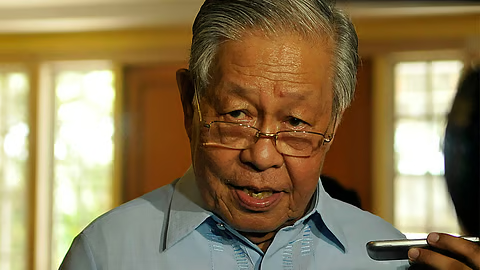

Your Honors, Senate President Sherwin Gatchalian, Presiding Officer Francis Escudero and esteemed Senator-Judges may please the Honorable Senate in performing its constitutional duty and power to try and decide impeachment cases.Thank you for inviting this humble retired Chief Justice as amicus curiae. Thank you too, for allowing me to speak first to enable me to attend this afternoon’s award ceremony of the Foundation for Liberty and Prosperity. Where 20 exemplary law scholars will be granted P250,000 each. Five MBA fellows will be granted P500,000 each. And five dissertation writing contest winners will be conferred more than P1.3 million pesos in prizes. In fact, Your Honors, assisting me today are the past recipients of these FLP awards. Arvin Cortez, at my back, Rachel Helia at Jacob Barbosa. Since, I will submit a copy of my written brief to you, your Honors. And together with my column on the Philippine Daily Inquirer, August 17, 2026. Titled two-thirds, I will confine my remarks today to only four points.
POINT ONE. As it’s generally known, an impeachment trial in the Senate is sui generis, Latin words that mean of its own kind or unique. It has both legal and political connotations. Pursuant to its legal character, the honorable senators conduct the trial in accordance with the law and evidence and the rules of court. Witnesses are examined by eagle-eyed lawyers ready to overwhelm them. Our people see senators garbed in their majestic crimson robes, lawyers arguing as if they were in a judicial courtroom. Politically, on the other hand, decomposition is not confined to lawyers or jurists. Rather, its membership is open to elected political leaders who need not obtain formal legal education, need not pass the excruciating bar examination and need not be scrutinized by the Judicial and Bar Council. Your honors are not sitting here as justices or lawyers. Truly, the Constitution does not require you to be lawyers or jurists. Neither are your honors expected to act like jurists or lawyers.
Notably, senators in the United States of America trying impeachment cases do not ape judges. They do not even wear judicial robes. Instead, they are garbed in their normal attire. But in this hall, you have deemed it necessary and proper that you are garbed in judicial robes. That’s why, in my case, I want to honor also this honorable court by being garbed in my judicial robe.
POINT TWO. The Constitution, as has been stated by the honorable presiding officer, states and I quote, the Senate shall have the sole power to try and decide all cases of impeachment. when seating for that purpose, the Senator shall be on oath or affirmation, which already have done. And then critically, no person shall be convicted without the concurrence of two-thirds of all the members of the Senate. Close quotation.
How do judges and justices interpret the provisions of the Constitution and for that matter, of laws. There are two major ways or methods. The first method is called verba legis. Words are plainly read and given their ordinary meanings. In such cases, there is, to quote the Supreme Court of the Philippines, no need for interpretation but only application of the provisions. Close quotation. The Senate, as we all know, has 24 members under the Constitution. Two-thirds of 24 is mathematically 16. Therefore, 16 votes are necessary to convict. If we must use mathematics. Indeed, mathematics, Your Honors, is an exact science in the abstract. To repeat, in the abstract. Why? Because 2 plus 2 is always 4 in the abstract. 3 plus 3 equals 6. 2 times 10 equals always 20. Therefore, 24 multiplied by two- thirds is always 16 in the abstract. But not always in reality. There’s a difference between abstraction and reality. For example, your honors, very simple. One small drop of water when put together with another small drop of water may become one bigger drop of water. So in reality, it is one big drop of water.
Reality, sometimes, your honors, changes the denominator in mathematics. In the same way, constitutional interpretation cannot always stop at abstract mathematics. We must look at the intent. and the purpose of constitutional provisions, the circumstances in which they operate, and the goals they seek to achieve.
Which brings us to the second method of interpretation, the ratio legis est anima or to quote the Supreme Court, the reason of the law is the soul of the law. The text must be understood within its constitutional ambiance. To shorten my presentation as we have time limits, I will leave it to my more learned retired colleagues, here present the jurisprudence on these two ways of interpretation. However, Your Honors, I have included in the footnotes of my presentation the jurisprudence beginning with the 1924 case of Fuentes versus Director of Prisons and the often quoted 1949 case of Avelino versus Cuenco, which is only the second, not the first, Your Honor, on this issue .Although in the case of Fuentes, this was decided prior to the Constitution, but under the Jones Law, which was the enabling act of the Philippines at that time in 1924. From the case of Avelino versus Cuenco, there are several other cases, up to the 2026 case of Generillo versus Senate. With which your honors must be familiar, since it also involves the present Senate and the present Vice President.
Relevantly, your honors may ask, should the interpretation of the drafters of the Constitution prevail? With due respect, not necessarily. In our Constitutional allocation and separation of powers and the principle of checks and balances, the makers of the law are not the final authorities. On interpretation, that delicate task is lodged in an independent branch of government, the judiciary, and in the present case, the Honorable Senate.
POINT THREE. Which of the two modes of interpretation should the Senate use in discharging its constitutional duty to try and decide impeachment cases? I respectfully submit, Your Honors, that it is neither. Repeat. Neither of the two. Why? Because, as I already said, senators are not jurists. They are not even lawyers. Some of you may be lawyers, but you’re not called here to decide as lawyers. You’re called upon by the Constitution to decide as lawmakers. In fact, Your Honors, you need not even use language or methods of magistrates with due respect. You are elected as representatives at large of the entire electorate. You are the co-equals of the justices of the Supreme Court. So how then should the Constitution be interpreted by the Honorable Senators?
In my humble opinion, in accordance with their mandate as representatives of the people, especially reflecting the common sense of the people, guided by two fundamental standards, namely truth and fairness. Truth and fairness. The standard of truth that is called from facts extracted, one, from studying and verifying the documents and papers submitted by the parties and two, from hearing witnesses and observing their demeanor on the stand in front of you. The tweets of their eyes, their body language, the tone of their voices, and the spontaneity of their answers. By watching and listening to them face to face, your Honors would know whether the witnesses are telling the truth, the whole truth, and nothing but the truth. Fairness, on the other hand, demands that we hear before we condemn, and that all sides are given the opportunity to explain their language and actions. It is what lawyers call due process, and what ordinary people believe as fairness. As the Greek philosopher, Themistocles, who was not a lawyer, one said, and I quote, “Strike me as you may, but hear me first.” Truly, I respectfully submit that active participation and independent evaluation of the evidence are essential to discharge the Senate and the Senators’ constitutional responsibility.
POINT FOUR. Is the judgment of the Senate based on truth and fairness appealable to the Supreme Court? My respectful answer is a big no. Because there is no constitutional provision allowing such an appeal. The Senate’s decision is final and unappealable.The only way by which the court can review a Senate decision or order is when the Senate commits grave abuse of discretion. Repeat: Not just ordinary abuse of discretion, but grave abuse of discretion. Grave abuse of discretion, Your Honors, is not defined by the Constitution. But jurisprudence characterizes it as, if I may quote, “capricious or whimsical or arbitrary exercise of judgment amounting to lock or excess of jurisdiction.” In simpler terms, the court does not review the Senate’s judgment, merely because the court disagrees with the judgment, merely because the court disagrees with the wisdom of the judgment. No, judicial review arises only when the Senate exercises its power in a capricious, whimsical, or arbitrary manner, thereby going beyond the limits of its constitutional authority. Thus, the Senate must hear the prosecution and the defense witnesses, as it already does, allow their councils to argue verbally and in writing, and study their presentations deeply. Only thereafter should it issue its orders and decisions. In this connection, is it truthful and fair to allow Senators to cast their votes despite being absent from the proceedings? Is it fair? And truthful, should the senators be allowed to vote though they were there in hiding, abroad, legally detained, sick, hospitalized, or otherwise absent, and have not been able to access and examine the documents, have not heard the testimonies, and have not observed the demeanor of the witnesses?
To put it more picturesquely, Your Honor, is it truthful and fair? To the parties, to our country, and to our people, to allow those abroad, those looking at the pyramids along the Nile or shopping in the fashion houses of Paris, or riding the romantic gondolas of Venice, or deliberately hiding in the dark corners of the world, while everyone here, everyone here in this hall, is sweating it out, listening to sometimes irrelevant and loquacious lawyers or to humble an ancient amicus curiae like me.
To conclude, Your Honors, may I say that you are tasked with a constitutional duty that cannot always be reduced to abstract arithmetic. Neither can such duty be performed in the shadows of absence, nor from legal impediments. As the elected representatives of the Filipino people, Your Honors mandate, in my humble opinion, demands a commonsensical, commonsensical, I repeat commonsensical interpretation of the Constitution. Indeed, meaningful adjudication requires active participation in the search for truth and fairness. I respectfully submit that only in this manner can your honors ensure a verdict that is fair to the parties, fair to your honors peers, and ultimately fair to our sovereign people. Maraming salamat po muli sa inyong paanyaya at masusing pakikinig sa inyong abang lingkod. Maraming salamat po.#