Serialized in full, every week, free — right here in The City Post.
Week 3. Chapter 3.
by Raffy Gutierrez
Download the free e-book Veneration Without Thinking here:
https://archive.org/details/veneration-without-thinking-by-raffy-gutierrez
Chapter 3: The Four Forms of Extremism — A Diagnostic Framework
Two weeks ago we said the map is not the territory.
Last week we asked you to separate three things you have probably been treating as one: what you know, what you believe, and what you are merely assuming.
This week we introduce a tool. A chart. A way of seeing extremism that is more precise — and more uncomfortable — than the way the word is usually used.
Because here is the problem with the word “extremist.” Most people hear it and picture the same thing: a man with a bomb, a manifesto, a willingness to kill for a cause. Extremism, in the popular imagination, is always loud. Always violent. Always obvious.
That definition lets most of the real damage off the hook.
The bomb goes off once. The quiet, institutional, respectable kind of extremism runs for five hundred years — and everyone calls it tradition.
What Extremism Actually Is
Before we draw the chart, we need a working definition. Not a dictionary definition. A diagnostic one.
Extremism is not about how loud you are. It is not about how much you are willing to hurt people physically. It is about three conditions — and when all three are present at the same time, you have extremism. Regardless of how it looks from the outside.
Condition One: Immunity to correction. The belief cannot be questioned, revised, or updated — no matter what evidence is presented. Any challenge to the belief is treated not as information to be evaluated but as an attack to be repelled.
Condition Two: Imposition on others. The belief is not held privately. It is actively enforced on people who do not share it — through law, through social pressure, through institutional power, through punishment of those who refuse to comply.
Condition Three: Ignored evidence of harm. People are being hurt. The evidence of that harm is visible, documented, undeniable. And it is ignored — because the belief is more important than the people the belief is supposed to serve.
Three conditions. All three must be present. One or two is not enough.
A person can hold a belief that cannot be questioned and still not be an extremist — if they keep it to themselves and hurt no one. A person can impose a belief on others and still not be an extremist — if they remain genuinely open to correction when shown evidence of harm. But when all three conditions are present simultaneously — immunity, imposition, and ignored harm — you have extremism. Whatever it is wearing. Whatever it calls itself.
The Chart
Now we can draw it.
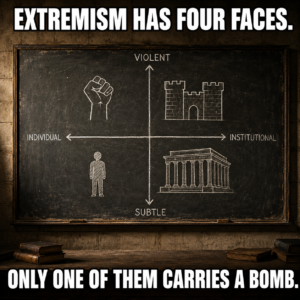
Two axes. The vertical axis runs from subtle at the bottom to violent at the top. The horizontal axis runs from individual on the left to institutional on the right.
This gives us four quadrants.
Top left: the violent individual. This is the person most people picture when they hear “extremist.” The lone attacker. The man with the bomb. He meets all three conditions: his belief is immune to correction, he imposes it on others through force, and he ignores the harm he causes — or celebrates it. He is real. He is dangerous. He is also, in terms of long-term damage to a society, the least efficient form of extremism. He can be arrested. He can be stopped. His damage is visible, immediate, and generates a response.
Top right: the violent institution. An organization or state that uses force to impose a belief system — inquisitions, religious wars, state-sanctioned persecution. History is full of examples. The Church has its own entries in this quadrant. We will not pretend otherwise.
Bottom left: the subtle individual. The person who holds an extremist belief privately — who has complete immunity to correction, who would impose it on others if they could, but whose individual power is limited. Dangerous in potential. Limited in immediate reach.
Bottom right: the subtle institution. This is the quadrant that does not get enough attention. This is where five hundred years of the most effective, most durable, most consequential extremism in Philippine history has lived.
Not bombs. Not armies. Pastoral letters. Senate testimony. Homilies. The quiet, consistent, fully documented use of institutional religious authority to block legislation, shape civil law, and tell one hundred and ten million people that their most intimate decisions — whom to marry, whether to leave, whether to start again — belong not to them but to an institution that has never lived inside a single one of those marriages.
Subtle. Institutional. Immune to correction — because the belief is declared sacred and beyond revision. Imposed on others — through civil law that enforces one religion’s theology on every Filipino regardless of faith. Ignoring evidence of harm — because the broken families, the trapped women, the children watching their parents destroy each other are not evidence of a policy failure. They are, in the Church’s framing, a test. An opportunity for redemptive suffering. A spiritual credential.
Three conditions. All three present. For five hundred years.
Why the Bishop and the Bomber Belong on the Same Chart
This is the line that will make some readers uncomfortable. Good. Discomfort is not the same as being wrong.
The bishop and the bomber are not the same person. They do not use the same methods. The moral distance between them is real and significant. I am not collapsing that distance.
What I am saying is that they share a structure. The same three conditions that make one man pick up a bomb make another man sign a pastoral letter opposing a divorce bill. Immunity to correction. Imposition on others. Ignored evidence of harm. The methods are entirely different. The architecture of the belief is the same.
This matters because it explains why the subtle institutional form is so much harder to fight than the violent individual form. You can arrest the bomber. You cannot arrest a five-hundred-year-old institution for the crime of convincing a nation that its map is the territory.
You can only name it. Examine it. And refuse, finally, to keep walking on floors you have never tested.
A Note on Who This Framework Is For
The quadrant is a tool, not a verdict. It is not designed to make you feel superior to anyone. It is designed to make you see clearly.
And what it asks you to see, clearly, is this: extremism does not require violence. It does not require hatred. It does not even require bad intentions. It requires only three things — a belief that cannot be corrected, imposed on people who did not choose it, while ignoring the harm that results.
By that standard, the question is not whether extremism exists in the Philippine Catholic institutional context.
The question is how long we are going to keep pretending it doesn’t.
— End of Chapter 3 —
Next week: Chapter 4 — The Price of Asking. What happens to the Filipino who decides to question. The social cost, the family cost, the personal cost — and why people keep asking anyway. Free, in full, every week, right here in The City Post. If this made you think, share it with someone who needs to.