by Raffy Gutierrez
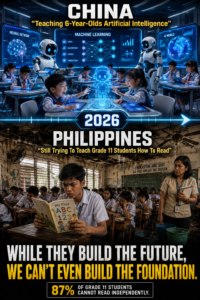
The two images sitting side by side in my mind are enough to make any patriotic Filipino weep — or rage. In one, a news headline confirms what many of us have long suspected but dared not fully confront: the Department of Education has admitted that 87% of Grade 11 students in the Philippines cannot read independently. In the other, children in China — some as young as six years old — are seated before tablets and screens, already enrolled in a mandatory national AI literacy curriculum that Beijing rolled out across every primary and secondary school beginning September 1, 2025. While one nation is programming the minds of its kindergarteners to shape the future, we are still trying — and failing — to teach our senior high schoolers the most fundamental skill a human being can possess: how to read. This is not merely an education crisis. This is a national catastrophe decades in the making, and the fingerprints of those responsible are not hard to find.
To understand how we arrived here, we must be willing to name uncomfortable truths and inconvenient legacies. The decline of Philippine education did not happen overnight, and it did not begin with any typhoon, pandemic, or budget cut. It began, many scholars and educators argue, with two pivotal decisions made by two presidents who share the same surname. The first wound was inflicted quietly, bureaucratically — when President Corazon Aquino’s administration institutionalized the shift away from English as the primary medium of instruction in Philippine schools. Through Department Order No. 52, Series of 1987, and reinforced by Executive Order No. 335 signed in 1988, the Cory government pushed aggressively for Filipino to replace English in official government communications and, critically, in the classroom. The intent — to assert cultural identity and national pride in the euphoric aftermath of People Power — was understandable. The consequence, however, was devastating. The Philippines, long celebrated across Asia for its English-proficient workforce, began the slow, painful erosion of a competitive advantage that took American-era schoolmasters generations to build. We traded a globally viable language asset for a nationalist symbol, and our children have been paying the price ever since.
The second, deeper wound came a generation later, courtesy of the son. President Benigno “Noynoy” Aquino III, in his characteristic fashion of bold optics and weak execution, signed the Enhanced Basic Education Act of 2013, forcing the entire country into the K to 12 program. On paper, the reform was long overdue — the Philippines was, indeed, one of only three countries in the world still running a 10-year basic education cycle. But the manner of its implementation was, to put it charitably, reckless. Critics from the Alliance of Concerned Teachers to the National Union of Students were unanimous: the country was simply not ready. There were not enough classrooms, not enough trained teachers, not enough textbooks — errors, both factual and grammatical, riddled the materials that were rushed into production. As one lawmaker asked pointedly at the time: “The Aquino government has yet to present a convincing program to remedy the existing shortages in the education sector. How can basic education qualitatively function amid these dire shortages?” The K to 12 program did not elevate Philippine education. It stretched an already broken system past its breaking point, added two more years of mediocrity onto the pile, and handed the next generation a diploma that meant progressively less with each passing year.
The numbers that have since emerged are not statistics — they are indictments. According to the World Bank, 91% of Filipino children aged 10 cannot read a simple, age-appropriate text — one of the worst rates in the entire Asia-Pacific region. The Philippine Statistics Authority’s own Functional Literacy, Education and Mass Media Survey (FLEMMS) of 2024 found that 24 million Filipinos between the ages of 10 and 64 are functionally illiterate, with 5.8 million unable to read or write even at the most basic level. One in five high school graduates in 2024 crossed that graduation stage functionally illiterate — unable to read a medicine label, interpret a job application, or understand a contract they might be signing. The Second Congressional Commission on Education (EDCOM 2), in its landmark “Fixing the Foundations” report, found that 70% of Grade 3 learners still struggle with foundational literacy skills — recognizing letters, reading common words, understanding short passages. By Grade 6, proficiency drops to a staggering 19.56%. By Senior High School, it falls to nearly zero. The system is not educating our children. It is processing them.
In international comparisons, the picture becomes even more humiliating. In the 2022 Programme for International Student Assessment (PISA), the Philippines ranked sixth from the bottom in reading and mathematics, and third from the bottom in science out of 81 participating countries. Filipino 15-year-olds scored 347 in reading — well below the OECD average of 476. In creative thinking, we ranked 60th out of 62 countries. These are not the results of a developing nation catching up. These are the results of a nation in freefall. The EDCOM 2 Comprehensive Rapid Literacy Assessment for School Year 2024–2025 confirmed the grim trajectory: nearly half of all Grade 3 learners — 48.76% — were not reading at grade level by the end of the school year. The foundation is not cracking. It has already collapsed.
Now consider what it truly means — the full, lived consequence — when a Grade 11 student cannot read independently. It means that for eleven years, this child sat in a classroom, was passed from teacher to teacher, was promoted from grade to grade, and was handed certificates of completion, while no one — no administrator, no policy, no safety net — intervened to address the most elemental failure in their education. It means this young person, on the cusp of adulthood, cannot read a job posting, cannot follow written instructions, cannot interpret a government form, cannot read a prescription correctly, cannot evaluate a news article for truth or propaganda. A functionally illiterate population, as the Philippine News Agency has noted, “is more vulnerable to misinformation — easy targets for scams and propaganda.” It is not a coincidence that a country where 87% of Senior High students cannot read independently is also a country where disinformation spreads like wildfire and where demagogues thrive with alarming ease. Illiteracy is not just an education failure. It is a democracy failure.
The economic toll is staggering and compounding. The World Literacy Foundation has calculated that illiteracy costs the Philippine economy an estimated ₱258 billion — or $4.72 billion — every single year, through lost earnings, diminished productivity, and constrained business growth. Economists at Ateneo de Manila University note that each year of functional schooling can increase wages by as much as 7%, meaning that illiteracy is, in effect, robbing workers of 7% of their potential income annually. As one analyst from BusinessWorld warned plainly: persistent poor literacy could mean billions of pesos in foregone income annually, especially as the economy becomes more digital and skills-intensive. The Philippines aspires to upper-middle-income status. It will never get there on the backs of a workforce that cannot read.
Meanwhile, on the other side of the South China Sea, a nation with its own deeply authoritarian flaws has made a decision that deserves to be noted regardless of one’s politics: China has chosen, unambiguously, to invest in the intellectual future of its children. Beginning September 2025, every student from Grade 1 through university is now required to receive a minimum of eight hours of AI literacy instruction per year — covering everything from basic concepts and ethics to machine learning and robotics for older students. The curriculum is not an elective. It is not a pilot. It is a mandate, backed by the world’s largest digital education platform, housing over 110,000 high-quality resources. We need not admire the Chinese government’s authoritarian model to recognize the lesson embedded in this contrast: when a nation decides its children’s minds are a strategic national priority, it acts with urgency and resources to match. The Philippines has never once treated its children’s minds with that level of seriousness.
What then must be done? First and most urgently, the government must abandon the culture of curriculum reshuffling as a substitute for genuine reform. MATATAG, K to 12, Mother Tongue-Based Instruction — every administration arrives with a new acronym and departs having made things worse. What is needed is not another curriculum. What is needed is a ruthless, obsessive, non-negotiable focus on foundational literacy from Kindergarten to Grade 3 — the window that every education expert agrees is make-or-break. Reading interventions must be structured, systematic, phonics-based, and monitored with real accountability. No child should be promoted to Grade 4 without demonstrated reading proficiency. Full stop.
Second, the teacher crisis must be treated as the emergency it is. The Philippines faces both a shortage of qualified teachers and a crisis in their quality of training. Teachers currently earn salaries that drive talent away from the profession and into overseas work. A nation that pays its educators poorly has decided, in the plainest possible terms, that it does not value education. Competitive salaries, aggressive pre-service training overhauls, and mandatory, ongoing literacy pedagogy coaching are non-negotiable. Third, the classroom deficit — estimated at 91,000 classrooms as of the 2023–2024 school year — must be addressed with the same urgency we apply to infrastructure projects that serve private interests. Children learning in the heat, in overcrowded rooms, without adequate materials, cannot learn. This is not a theory. This is physics.
For future leaders — those who will run this country in the next decade — the mandate must be unambiguous: education cannot be a political football. It cannot be the portfolio given to a vice president as a consolation prize, or the department whose budget is raided when other priorities emerge. A genuine, non-partisan, decade-long National Education Emergency Plan must be declared, funded, and insulated from the electoral cycle. EDCOM 2 has already produced a roadmap — the National Education and Workforce Development Plan 2026–2035. The question is whether any future leader will have the courage and the continuity to follow it, or whether it will gather dust like every reform document before it. Future leaders must also have the intellectual honesty to acknowledge that the Philippines cannot leapfrog to AI literacy when it has not yet secured basic literacy. A child who cannot read cannot code. A student who cannot comprehend a paragraph cannot evaluate an algorithm. The foundation must be built before the upper floors can stand.
The Philippines is a nation of extraordinary people — resilient, creative, adaptive, deeply human. Our diaspora runs hospitals in London, powers the maritime industry worldwide, and raises families across every continent on earth. But that diaspora exists, in part, because the country failed to build the conditions for its brightest to thrive at home. The brain drain is not a compliment — it is a verdict on what we have built, or failed to build, here. And every year that we allow 87% of our Grade 11 students to navigate the world without the ability to read, we are manufacturing the next generation of that diaspora — except this time, many of them will not have the skills to leave, and will instead remain, trapped in poverty, vulnerability to manipulation, and a lifetime of foreclosed opportunity.
Here is the truth that no politician wants to say out loud, so this column will say it plainly: if we do not act — not study, not consult, not form another commission, but act — with radical urgency and sustained political will in the next five years, we will have produced an entire generation of Filipinos who are functionally illiterate and wholly unprepared for the world that awaits them. A generation that cannot read a contract, cannot evaluate a candidate, cannot compete for a decent job, cannot protect itself from misinformation, and cannot participate meaningfully in its own democracy. Not a generation that is behind — a generation that is lost. While six-year-olds in China are learning to think with machines, we are still failing to teach our seventeen-year-olds to read. We have run out of time for slow reform, political theater, and bureaucratic excuses. The classroom is on fire. And our leaders are still debating what to call the curriculum.
Are we going to sit around to wait until the next generation of Filipinos become future slaves of the world?
_________________________
Rafael “Raffy” Gutierrez is a Technology Trainer with over 25 years of experience in networking, systems design, and diverse computer technologies. He is also a popular social media blogger well-known for his real-talk, no-holds-barred outlook on religion, politics, philosophy.