
by Raffy Gutierrez
One of the most comforting lies we tell ourselves as a nation is this: “At least the intention was good.”
We say it after failed programs. After delayed projects. After wasted budgets. After reforms that never reform anything. As long as the speech sounded sincere and the promise felt hopeful, we justify the judgment. We forgive the outcome because we want to believe the motive was pure.
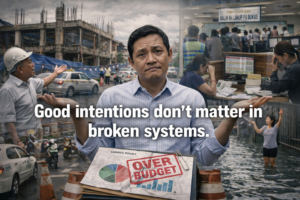
But here’s the uncomfortable truth: in broken systems, good intentions are irrelevant.
A system does not respond to intentions. It responds to structure, incentives, design, accountability, and consequences. You can fill a room with well-meaning people, but if the incentives reward delay, protect incompetence, and punish transparency, the outcome will still be failure. Always. Let that sink.
This is where we keep getting trapped.
We evaluate leaders based on empty promises instead of platforms and execution. We measure programs by announcements instead of impact. We defend policies because the vision sounded noble. But systems don’t run on emotion. They run on architecture.
If a process is designed to be confusing, it will confuse—even if the people implementing it are kind.
If procurement rewards connections over competence, corruption will flourish—even if the original proposal was sincere.
If no one loses their job when a project collapses, collapse becomes part of the operating model.
Intentions don’t override structure.
And yet we keep clinging to them.
Why? Because intentions are easier to defend than results. Intentions are intangible. You can’t measure them. You can’t audit them. You can’t prosecute them. But outcomes? Outcomes are visible. They either work or they don’t. A project that wasn’t built but was given a budget is a ghost project. And now the whole Philippines has been dragged into one of the greatest corruption scandals in history because sometime in the past, someone said flood control programs will be great. But most of them were never even built (in spite of the budget allocation for them).
When we accept good intentions as a substitute for outcomes, we remove pressure from the system. We lower the bar quietly. We normalize mediocrity with empathy.
Empathy is good for people. It is dangerous when applied to broken architecture.
Think about it this way: if an engineer builds a bridge that collapses, do we say, “At least he meant well”? If a pilot crashes a plane, do we say, “But his heart was in the right place”? In high-stakes environments, outcomes matter because lives depend on them.
Public systems are no different. Healthcare delays cost lives. Traffic inefficiency costs productivity and family time. Broken databases cost trust. Poorly designed welfare systems cost dignity. These are not abstract inconveniences. They shape daily reality.
Good intentions without competence create damage with a smile. That smile reflects Filipino resiliency as they say. And where has all this smiling because of resiliency led our country. Even Vietnam has already surpassed us!
And here’s the part we rarely admit: sometimes intentions are used as shields. They soften criticism. They redirect scrutiny. They turn performance reviews into emotional debates. Instead of asking, “Did this work?” we ask, “Are you questioning their sincerity?”
That is how accountability dies.
A mature society separates personal decency from professional competence. Someone can be kind and still be unfit for the role. Someone can have passion and still lack skill. Leadership is not about heart alone. It is about delivery. BBM’s heart seems to be in the right place but he has yet to deliver.
Broken systems survive because they reward sentiment and tolerate failure.
Functional systems survive because they reward outcomes and penalize incompetence.
If we want real change, we have to grow up collectively. We have to stop grading governance on effort. We have to stop applauding proposals. We have to stop confusing potential with performance.
Ask harder questions:
Did it work?
Did it reduce suffering?
Did it simplify life?
Did it save time?
Did it close the loop?
If the answer is no, then the intention does not rescue the result.
We deserve systems that work—not systems that try. Even Master Yoda of Star Wars once said, “There is no TRY, only DO.”
The day we stop being satisfied with “at least they meant well” is the day broken architecture begins to crack. Because when outcomes become the only acceptable measure, excuses lose power.
And when excuses lose power, reform finally becomes possible. We can probably get out of this rotten reality our nation has been stuck in since forever.#


