by ACT Teachers Rep. and Deputy Minority Leader Antonio L. Tinio
Secretary Vince Dizon recently announced that the DPWH would finally scrap a notorious policy tool, sometimes referred to in media coverage as the “Cabral formula,” in preparing the budget for fiscal year 2027: “The allocables will be gone. That allocable system – whatever it is, which to this day I still have a hard time understanding – is gone.”
Despite what Sec. Dizon says, the “allocable system” or formula is not obscure or inscrutable. Nor is it a thing of the past that should be forgotten and consigned to the dustbin. Perusal of the policy reveals that it is key to understanding why and how the massive ransacking of the Treasury through the DPWH took place in the first three years of the Marcos Jr. administration. In fact, the DPWH “allocable system” is a systematic blueprint for centralized plunder that names the President, his Cabinet, and leaders of the House and Senate as the primary proponents and beneficiaries of pork barrel insertions.
The flood control corruption scandal has exposed not just isolated corruption, but a systematic, top-down scheme of plunder institutionalized at the very start of the Marcos Jr. administration. At the heart of this system is a policy tool known as the “Baselined-Balanced-Managed” Parametric Formula used to determine infrastructure budget allocations to legislative districts in preparing the annual budget of the DPWH.
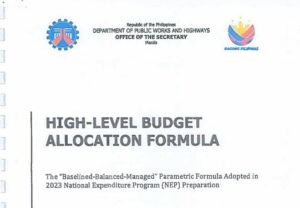
The formula, attributed to the late Undersecretary Maria Catalina Cabral, is contained in a 16-page document entitled “High-Level Budget Allocation Formula: The “Baselined-Balanced-Managed” (BBM) Parametric Formula Adopted in 2023 National Expenditure Program (NEP) Preparation” issued by the Office of the Secretary of the DPWH in July 2022, at the very onset of the Marcos Jr. administration.
This formula was used by the DPWH to prepare its proposed budget from 2023 up to the recently enacted 2026 General Appropriations Act, dubiously touted as “corruption-free.”
The BBM Parametric Formula is presented in three stages, mostly based on a set of parameters (hence, “parametric”), seemingly intended to provide a veneer of objectivity in the budget preparation process:
- “Baselined” – sets a minimum allocation using 6 years of historical data such as previous infrastructure allocations, population, and land area.
- “Balanced” – applies adjustments for poverty incidence, infrastructure density, climate vulnerability, and the legislative district’s absorptive capacity or efficiency implementing projects.
- “Managed” – this is the stage where adjustments are made to the mathematically derived allocation determined in the first two stages, based on “higher considerations.” This is the critical stage where the “technical” results are overridden.
The document itself states:
“Part III. MANAGED — and ADJUSTED to be dynamic, practical and reasonable, based on other budget constraints and national programs of DPWH according to its core mandate and functions as well as those of the national government to include other emerging priorities.
“Moreover, considering that the national budget is a economic, political, and legal tool of the national government all at the same time, the DPWH BBM Allocation Formula should be able to take into account higher considerations in decision-making, beyond engineering and economic development of DPWH. Priorities of the leaders of the national government and the legislature will also be considered in this matter.” [“High-Level Budget Allocation Formula,” page 6]
This admission is the smoking gun. The language used is a telling giveaway. It explicitly names “priorities of the leaders” instead of “priorities of the administration”—meaning individual officials, not institutional mandates. This is an official admission that the budget is adjusted to serve the personal priorities of powerful individuals.
And who are these individuals? The DPWH policy document all but names them: “leaders of the national government and the legislature” can only refer to none other than the President and his cabinet and the leadership of both chambers of Congress.
This is pork barrel by design. The “big fish” proponents are acknowledged. Issued by the Office of the Secretary of the DPWH, then led by Sec. Manuel Bonoan, on July 2022 – the formula embeds the pork barrel system in official DPWH policy at the very start of the Marcos Jr. administration and ushers in the period of unprecedented plunder of DPWH funds we now call the “flood control scam.”
The bombshell revelations by whistleblowers such as DPWH Usec. Roberto Bernardo and Bulacan District Engineer Henry Alcantara as well as those found in the so-called “Cabral files,” should therefore be seen in this light. The alleged submissions of project proposals by the President, cabinet officials, as well as leaders of the House and Senate are not anomalous interventions but routine implementations of the policy.
It should also be noted that the BBM parametric formula confirms the evolution of DPWH corruption from a “retail” system, where individual legislators fought for their own pork, to a centralized, syndicated, and more efficient system of plunder. All insertions must now flow through and be approved by the top leaders. Consequently, the massive kickbacks—now paid upfront as “advances” or “committments” by contractors—are also centralized, with the biggest cuts allegedly going to the biggest fish: the President, his Cabinet, and the leadership of Congress.
The formula also explains the critical distinction between ‘allocable’ and ‘non-allocable’ – informal terms in the glossary of corruption that gained notoriety under this administration. The ‘allocable’ amount represents the baseline mathematical entitlement derived from the formula’s scientific parameters; this is the portion typically controlled by the local district representative, who manages the selection of contractors and local implementation. On the other hand, the ‘non-allocable’ amount is the variance introduced by the ‘Managed’ variable—discretionary funds controlled by national leaders rather than the district representative. While the local representative cannot claim these funds, they may receive a ‘cut’ for hosting them (known as ‘parking’) or find that such projects, facilitated by the DPWH central office, are implemented in their district without their consent, coordination, or any remuneration (‘sagasa’).
A final note on the nomenclature for the BBM Parametric Formula. Branding what was the official DPWH budget policy as the “Cabral formula,” together with claims by key players in DPWH that only Usec. Cabral understood it, are a deliberate strategy by the DPWH leadership and Malacañang to distance themselves from the corrupt system they created and benefited from and place the onus on a single official. Cabral was undoubtedly an influencial career bureaucrat in DPWH, with the technical know-how to devise the parametric formula and the political savvy to package it with the sycophantic “BBM” branding. But it is farfetched to suggest that she pulled the strings. In short, instead of the “Cabral formula,” it should be called by its proper name, the “BBM formula” – all the more fitting since the plunderous aftermath of its ruthless implementation in the past three years has inescapably defined the Marcos Jr. presidency. Instead of sweeping it under the rug, the DPWH must officially acknowledge and own this document as its policy from 2023 to 2026, for which Secretary Bonoan and the Office of the President are ultimately responsible.
The “BBM formula” is the blueprint for grand corruption. It institutionalized kickbacks at the highest levels. Therefore, the investigation must not stop with underlings, mid-level officials, or contractors. It must pursue the document’s own logic and follow the trail upwards to the “big fish” it has named.
We demand a full investigation into the role of former Secretary Manuel Bonoan, who was allowed to resign and leave the country, and into all identified proponents in the “Cabral files” and whistleblower testimonies, including those of Usec. Bernardo and the fugitive former chair of the House Committee on Appropriations Zaldy Co—from the President himself and his Executive Secretary and on to the leaders of the House and Senate. The Filipino people deserve to know who the “leaders of the national government and the legislature” are who prioritized their own pockets over effective flood control, resilient infrastructure, and the people’s welfare. ###
[Note: An interactive simulator of the ‘Baselined-Balanced-Managed’ Parametric Formula is provided at https://dpwh-formula.onrender.com/. The full 16-page source document, ‘High-Level Budget Allocation Formula,’ may also be downloaded as a PDF directly from the site.]