Photo from PCG spokesman Jay Tarriela’s Facebook page
The Communist Party of the Philippines (CPP) has criticized what it described as the hypocrisy of Philippine officials and lawmakers who have launched verbal attacks against China while remaining silent on the growing presence of U.S. military forces in the country.
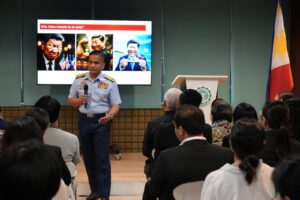
In a statement, the CPP pointed to the recent word war between Philippine Coast Guard (PCG) spokesperson Commodore Jay Tarriela and Chinese embassy deputy spokesperson Guo Wei.
Tarriela had posted mock images ridiculing Chinese President Xi Jinping, prompting Guo to denounce the act as political provocation and a violation of diplomatic norms.
Senators led by Risa Hontiveros responded by condemning Guo’s remarks as “undiplomatic” and pushing for a resolution against China, with some lawmakers proposing to declare the Chinese official persona non grata.
The CPP said Tarriela’s actions were “calculated to provoke China” and alleged that he was advancing U.S. policy interests, citing his training in Washington and close collaboration with American defense analysts.
The group argued that such moves overshadowed diplomatic efforts, including the January 16 Bilateral Consultation Mechanism in Xiamen, and ignored recent cooperation between the PCG and the Chinese Coast Guard in rescuing a Filipino fisherman.
The CPP further accused senators of double standards, noting that while they denounce China, they have not opposed U.S. military expansion under the Enhanced Defense Cooperation Agreement (EDCA) and other security pacts. It cited the Senate’s ratification of the Philippine-Japan Acquisition and Cross-Servicing Agreement (ACSA) and the Reciprocal Access Agreement (RAA), which it said compromise national sovereignty by allowing foreign military access to Philippine ports and facilities.
According to the CPP, U.S. forces have quietly expanded operations in the country, including the deployment of the Army Rotational Force-Philippines and naval maneuvers within the exclusive economic zone. It warned that these developments increase the risk of the Philippines being drawn into a regional conflict serving U.S. strategic interests.
The group also linked the escalation of anti-China rhetoric to what it described as the U.S.’s growing international isolation, citing its interventions in Venezuela, Cuba, Iran, and other countries.
It argued that portraying China as a threat diverts public attention from U.S. military build-up and global backlash against American policies.
“The Filipino people must stand firm for national sovereignty and demand freedom from all foreign military troops,” the CPP said, warning that continued U.S. expansion could drag the Philippines into a devastating war. (ZIA LUNA)