
by Raffy Gutierrez
There is a verse in the Bible that has echoed through centuries because of how brutally honest it is about human greed and ambition:
“For what shall it profit a man if he gains the whole world, yet forfeits his soul?”
For most of human history, people interpreted that verse as a warning against personal greed. A man obsessed with wealth. A businessman consumed by power. A ruler willing to sacrifice morality for ambition.
But today, that verse feels less like ancient spiritual wisdom and more like a direct indictment against modern political corruption — especially in countries where public office has become a gateway to dynasties, hidden wealth, and the systematic looting of a nation.
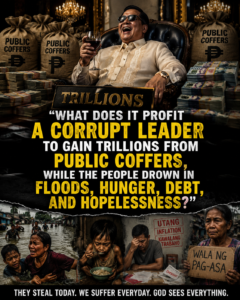
Because what exactly does it profit a politician to gain trillions from public coffers while his people drown in floods, inflation, debt, hunger, and hopelessness?
That is no longer merely corruption. That is spiritual bankruptcy on a national scale.
There was a time when corruption in the Philippines was discussed almost casually. “May corruption talaga.” “Normal na yan.” “Lahat naman magnanakaw.” The problem is that we normalized theft so deeply that we failed to notice when corruption evolved from simple greed into something far more destructive: the deliberate sacrifice of the nation itself for personal enrichment.
Every flooded street today is no longer just a natural disaster. It is evidence. Every collapsed public service is evidence. Every unfinished drainage project, overpriced infrastructure contract, ghost project, delayed transport system, malfunctioning flood control system, and hospital lacking medicine is evidence that somewhere, somebody chose personal wealth over public welfare.
And perhaps the cruelest part is this: the people paying the price are almost never the politicians themselves.
When floods consume entire communities, politicians sleep in elevated subdivisions protected by generators, security, and private resources. When inflation rises, ordinary Filipinos skip meals while those in power dine in luxury hotels. When fuel prices surge, workers commute for hours under heat and rain while convoys with police escorts speed through traffic untouched by the suffering around them.
This is why the Bible verse becomes terrifyingly relevant.
Because greed is no longer simply about a man losing his own soul. In modern politics, greed metastasizes outward. One corrupt leader can drag an entire nation into suffering. One administration driven by self-preservation rather than nation-building can set back generations of progress.
And what makes this tragedy worse is that many politicians already possess more wealth than they could ever spend in multiple lifetimes.
So why continue?
Because greed has no finish line.
The spiritual danger of greed is that it destroys the ability to recognize “enough.” A greedy man can own ten houses and still crave an eleventh. He can steal billions yet remain terrified of losing power. He can become president yet still behave like a desperate man scavenging for more.
That is why corruption often appears irrational from the outside. Ordinary citizens ask: “Why steal more if you are already rich?” The answer is because greed eventually stops being about necessity. It becomes addiction. A bottomless hunger.
And like all addictions, it consumes everything around it.
History has repeatedly shown that nations do not collapse solely because of foreign invasion or lack of talent. Many nations rot internally first. Institutions decay. Accountability disappears. Public trust erodes. Cynicism replaces patriotism. Citizens stop believing the government can ever improve because they perceive the system itself as predatory.
When corruption reaches that level, the greatest casualty is no longer money.
It is hope.
Once people lose hope in institutions, they stop dreaming about the future. They stop believing hard work matters. They stop believing honesty matters. Young professionals leave the country. Skilled workers seek opportunities abroad. Entire generations begin treating migration not as ambition but as escape.
And that may be the greatest national tragedy of all.
A corrupt politician does not merely steal money.
He steals futures.
He steals infrastructure that could have prevented floods. He steals medicines that could have saved lives. He steals classrooms from students. He steals opportunities from workers. He steals trust from citizens. He steals hope from the poor.
Then eventually, he steals the soul of the nation itself.
The Bible verse asks a profound spiritual question because it recognizes a brutal truth: there comes a point where material gain can no longer compensate for moral decay.
A nation can accumulate debt, infrastructure, loans, projects, slogans, press conferences, and political propaganda. But if the foundation beneath all of it is corruption, greed, and self-interest, then eventually the system collapses under the weight of its own dishonesty.
No amount of image-building can permanently hide moral failure.
No amount of political machinery can permanently suppress reality.
Because reality arrives eventually — through floods, economic decline, public anger, collapsing institutions, and a generation increasingly questioning where their taxes truly went.
The warning of that Bible verse was never merely about religion.
It was about civilization itself.
Because once greed becomes stronger than conscience, even the richest kingdoms eventually decay from within. And the current administration under President BongBong Marcos has taken greed to an unfathomable level.
—
Rafael “Raffy” Gutierrez is a Technology Trainer with over 25 years of experience in networking, systems design, and diverse computer technologies. He is also a popular social media blogger well-known for his real-talk, no-holds-barred outlook on religion, politics, philosophy.