
by Diego Morra
After three decades of inflicting harm on Filipino workers, the House of Representatives finally appeared to have woken up from its slumber and approved what it believes to a measure that guarantees “equal work for equal pay” through a National Minimum Wage System that would replace the patently pro-capitalist Regional Tripartite Wages and Productivity Boards (RTWPBs) with the National Wages and Productivity Commission (NWPC.)
However, it is still a bill that passed through a Lower House panel and it is far removed from the real demand of workers, which is to immediately pass legislation that sets a national minimum wage. This issue is of utmost urgency since the real inflation rate is higher than the 1.5% touted by both the Philippine Statistics Authority (PSA) and the Department of Economy, Planning, and Development (DepDEV), both of which have falsely claimed that with P64, each Filipino can have three square meals a day.
The Kilusang Mayo Uno (KMU) reacted to the approval of the measure at the committee level but insisted that the NMWS would only start equalizing minimum wages on the third year, well past the current Marcos Jr. administration. If the intent were to correct the bogus econometrics of the regime, the Lower House could have championed an immediate increase of the minimum wage that is based on the family living wage of P1,200, KMU chairman Jerome Adonis said on Dec. 10, which is actually the International Human Rights Day.
For Filipino workers, raising the minimum wage now is doable, particularly now that most corporations have been earning double-digit profits, never mind if their earnings come not only from operations but also through money market placements and purchases of Treasury bills. As one labor expert admitted, corporations spent less than 7% of their money for wages. Workers are actually their most productive investments even if the most rabid neoliberals and fanatics of the racist Friedrich Hayek demand the least control over wages and allow the untrammeled operations of oppressive and exploitative corporations.
Adonis acknowledged that the NMWS may be a step in the right direction and it came 36 years after the Cory Aquino administration was compelled to raise wages by P25 through the Wage Rationalization Act after workers struck nationwide. In June 2025, the Lower House passed a P200 daily minimum wage increase bill (House Bill 11376) but the Senate, populated as it is by the representatives of the bourgeoisie and servitors of domestic and foreign chambers of commerce, practically killed it, allowing the regional wage board tightwads to determine wages under the illusion that rural workers are immune from the ravages of urban inflation.
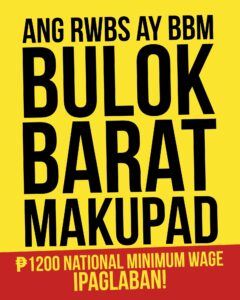
“Gayunpaman, mauuwi rin ito sa pagkabigo na i-angat ang kabuhayan ng mga manggagawa kung hindi ito ibabatay sa family living wage o P1,200 – ang minimum na kinakailangan ng isang lima-kataong pamilya upang matugunan ang kanilang mga batayang pangangailangan. Nailalantad din sa pagpasa ng NMWS Bill ang higit tatlong dekadang kainutilan ng RWBs at ang kapalpakan ng mga ito na itaas ang sahod sa nakabubuhay na antas. At sa ilalim ni Marcos, nananatiling ‘BBM’ ang Regional Wage Boards – Bulok, Barat, at Makupad. Patunay ang milyun-milyong manggagawang nasasadlak sa kahirapan at kagutuman dahil sa nakamamatay-sahod na napapanahon nang buwagin ang mekanismong ito ng pagtatakda ng sahod,” Adonis stressed.
The KMU leader said Filipino worker still face the bigger challenge of asserting the right to a decent wage. “The struggle of Filipino workers continues in all industries and sectors, in whatever region or corner of the country, in public or private enterprises. The fight for living, decent wage will be pursued with vigor and ardor.” Naturally, the foremost lobbyists for big business will bitterly oppose the bill, particularly those who have been viscerally opposed to any increase in wages, like warehousemen who represent plutocrats who have warned that foreign investors would pull out if Filipino workers receive higher wages, elements of the Foundation for Economic Freedom (FEF) who have denounced wage setting and former lawmakers who have argued that Filipino workers have the highest wages in the region, explaining that such rates deter foreign direct investments (FDIs), as if the nation would sink without foreign capital.
One servitor of foreign capital went as far as claiming that the Philippines is autarkic despite its accession to GATT-WTO and a surfeit of legislation providing perks for foreign investors. Or accession to free trade agreements in which trade issues are not settled by Philippine courts. Talk of a sodomized economy and you more of it by the operations of people who subvert industrial and agricultural sovereignty. Some of the worst lobbyists argue that there should not be any national minimum wage since pay should be determined at the enterprise or micro-level. This is like saying the world should go back to the 12-hour work day (as it is in China) or the employment of 10-year-olds to maximize profits. So, down with International Labor Organization (ILO) standards and all other norms policies that protect workers?


