
by Diego Morra
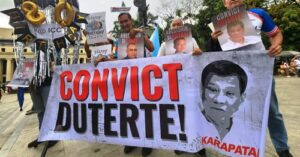
What should have been big news on Nov. 28 is not the rejection the appeal of Rodrigo Duterte to be granted interim release by the International Criminal Court (ICC) after being charged with crimes against humanity. Far bigger, of course, are the continuing rejection of the ICC’s jurisdiction over the unlamented ex-president by the families of Duterte, the weak arguments presented by his counsel about the cognitive decline of his client (which the Dutertes rejected), the pressure exerted by the pickets by Duterte zealots in The Hague, and the joke that some countries are competing to host the detained Duterte.
Moreover, the psychiatric and neurological assessment of Duterte Sr. did not lend credence to their claim that he could no longer recognize his counsel and members of his families, which are surefire evidence of frontotemporal dementia, and the appeal eventually collapsed. Add the daily arrant madness about springing the detainee from Scheveningen Prison and other plots for a great escape, as well as the massing of partisans to “rescue” him from the clutches of the ICC, and you have proof that counsel for the victims Kristina Conti was right all along, that the ICC would unanimously junk the plea for interim release. In short, the Dutertes defeated themselves. They are engaged in a judicial battle that they, themselves designed to lose.
Reporting for Al Jazeera, Ted Regencia wrote on Nov. 28, 2025 that the ICC Appeals Chamber rejected the plea for the interim release of Duterte, junking all three grounds cited by defense lawyers for his release, maintaining that the risk of flight is high and that he may just evade trial once he is granted interim release. Moreover, witnesses and the relatives of the victims may be harassed and subjected to physical violence, even murder, once Duterte resumes issuing orders to members of his cult. These possible actions may only be avoided if he is kept under 24-hour watch at the Scheveningen Prison, a panopticon-like detention facility. It is squarely not in the interest of justice that the architect of the bloody “war on drugs” be granted the opportunity to continue his bloody campaign in the Philippines.
“Having rejected the three grounds of appeal, the appeals chamber unanimously confirms the impugned decision,” the ICC Appeals Chamber president, Judge Luz del Carmen Ibanez Carranza, declared. The National Union of Peoples’ Lawyers (NUPL), which represents families of the victims of the war on drugs welcomed the decision, saying the detention “is crucial for victims and witnesses to feel safe coming forward. It is an assurance that he cannot simply intimidate persons, interfere with evidence, or disrupt proceedings.” Estimates of the death toll during Duterte’s presidential term vary. National police put the figure at more than 6,000, while human rights groups have claimed up to 30,000 killings. Conti, a leading human rights lawyer who represents the families of victims, expressed 99% confidence that Duterte’s appeal would be rejected. “There’s strong evidence why he should stay in jail,” she argued. Conti said in a statement posted on social media.
Conti, the NUPL and other Filipino human rights lawyers opposed the plea of Duterte for interim release, arguing that he should be the last man to be granted interim release. When ICC prosecutors announced in February 2018 that they would open a preliminary investigation into the violence that took place during Duterte’s mayorship in Davao City, Duterte did not only ridicule the ICC prosecutors but also cursed them for meddling into the country’s internal affairs. That preliminary investigation paved the way for the country’s withdrawal from the Rome Statute that created the ICC. In March 2018, Duterte announced the Philippines was withdrawing its membership from the ICC and junking its ratification of the treaty that created the international tribunal.
Even if he were a lawyer, like his daughter Sara, Duterte forgot that the statute that created the ICC did not give a free pass to dictators and fascists to avoid the long reach of international law. Repudiating the statute did not absolve him of the criminal charges lodged against him before the Office of the Prosecutor (OTP) of the ICC. The charges against Duterte date from November 1, 2011, when he was still mayor of Davao City, to March 16, 2019, when the withdrawal from the ICC took effect. ICC jurisdiction over him did not disappear through the expediency of withdrawal. The crimes against humanity lodged against him happened when the Philippines was still a signatory to the treaty, making him liable in the purview of ICC and international law.
The Dutertes were hoping against hope that the Appeals Chamber would look kindly at their plea. Yet, the factual and legal findings of the Pre-Trial Chamber (PTC) in September 2025 were seamless in arguing that Duterte does not deserve interim release. Under Article 58(1)(b) of the Rome Statute, there are three factors that compel detention of the accused: to ensure that he or she would be present during hearings; he or she would not hinder or endanger the investigation or trial, and; prevent the accused from committing crimes covered by the ICC. On all three counts, the Duterte appeal crashed.
By banking on humanitarian grounds to win Duterte’s interim release, the defense counsel failed to see that the accused faces charges of crimes against humanity and in the history of the ICC, there has never been an instance when anyone similarly charged was granted interim release. The gravity of the case behooves the ICC to protect humanity first before granting an unrepentant accused the chance to resume his war against the Filipino people. “Wala pang suspek o akusado sa ICC na nabigyan ng interim release sa mabigat na kasong crimes against humanity sa ganito kaaga sa proseso. Maingat ang korte na hindi maging exercise in futility ang anumang gagawin nito,” Conti explained. Additional Duterte appeals would most likely be for naught.


